


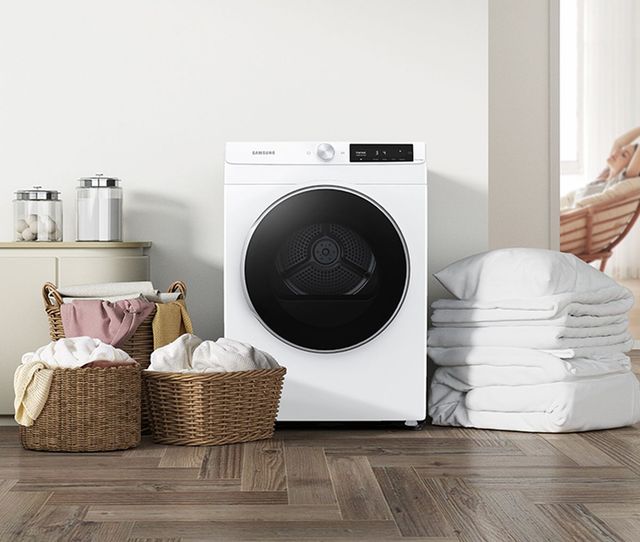
The tape measure stops at 27 inches inside a Fort Worth condo laundry closet, and every wall in that closet is an interior wall, with no path to the outside within 20 feet. A second-floor hallway closet in a Plano two-story has the opposite problem, a single 120-volt outlet, no 240-volt receptacle anywhere near it, and exactly 74 inches from the floor to the underside of a wire shelf. Both spaces are meant to hold laundry. Neither one will legally hold a conventional vented pair, because a vented dryer has to push hot, humid air through a duct to the outdoors. That gap is where a ventless dryer stackable washer setup earns its keep, turning a closet with no duct and no dryer circuit into a working laundry room.
Fit a Full Laundry Into a Closet With No Vent
Our team matches ventless dryers to real closet dimensions across Dallas–Fort Worth every week, from 24-inch compact heat pump models to full-size ventless units. Shop dryers, matching washers, stacking kits, and professional installation in one place.
Explore ventless dryer stackable washer optionsThe encouraging part is that both of those closets are solvable, and the fix is a product category rather than a remodel. At Texas Appliance, our team helps Dallas–Fort Worth shoppers compare ventless dryers in person, measure the space they actually have, and get the stack installed and serviced by people who live here. This guide covers how ventless drying works, heat pump versus condenser technology, how to measure a stacked column correctly, the electrical and drainage requirements that decide delivery day, stacking kit compatibility, and the specific models worth shortlisting.
Key Takeaways
- No duct means no exterior wall required: A ventless dryer condenses moisture inside the cabinet and drains it as water, so it installs in an interior closet, a condo, or a second-floor hallway where a vented dryer cannot go.
- Voltage is the biggest install blocker: Many compact 24-inch ventless dryers run on a standard 120-volt outlet, while most full-size ventless models need a dedicated 240-volt circuit.
- Stacked height decides the purchase: Compact 24-inch pairs land near 67 to 70 inches stacked and full-size 27-inch pairs commonly reach 76 to 80 inches, so shelves, soffits, and ceiling height matter as much as width.
- The stacking kit is model-specific: Only a manufacturer-approved kit for that exact washer and dryer pairing keeps the stack safe and keeps warranty coverage on both machines intact.
No Duct, No Problem: How Ventless Drying Fits Where Vented Dryers Cannot
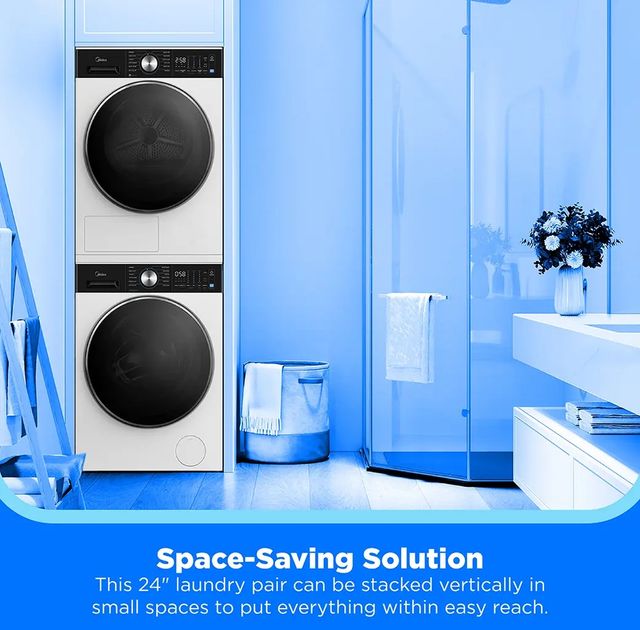
A ventless dryer is a dryer that pulls moisture out of your clothes and condenses it into liquid water inside the machine instead of exhausting hot, humid air through a duct to the outdoors. That water either drains away through a hose or collects in an internal reservoir you empty. Nothing gets pushed through a wall, which is the entire reason the category exists.
The airflow runs in a closed loop. Heated air moves through the drum and picks up moisture from the load, then hits a cooler surface where that moisture condenses out and falls away as water. The now-drier air gets reheated and sent back through the drum, over and over, until the moisture sensor says the load is done. Lint is caught in two places on these machines, a primary filter at the door and a secondary evaporator or condenser filter deeper in the cabinet.
Take the duct out of the equation and the installation rules change completely. With no rigid duct run and no hole to cut through an exterior wall, the dryer can sit on top of a front-load washer anywhere the plumbing and power reach. That is why a ventless dryer stackable washer configuration dominates laundry closets, apartments, older condos in Dallas and Fort Worth, and second-floor laundry rooms where ducting to the outside would mean opening walls.
A Ventless Dryer Is Not an All-in-One Combo
These two products get treated as interchangeable in search results, and they are not the same thing at all.
A ventless dryer is a standalone dryer. It has its own drum, its own controls, and its own cycle list, and it is designed to stack on a matching front-load washer. An all-in-one washer-dryer combo is a single machine that washes and then dries in the same drum, and nothing stacks on top of it or under it. The combo wins when the closet is too short for a column. The stacked pair wins on capacity, speed, and the ability to replace one machine instead of two.
You will run into two ventless technologies while shopping, heat pump and condenser. The next section puts them side by side against a vented dryer so the differences are easy to see.
Read more:
Heat Pump vs Condenser vs Vented Dryers for Stackable Washer Setups
Read the table by finding your voltage first, then your capacity need, then the cycle length you can tolerate.
| Dryer Type | How It Removes Moisture | Typical Voltage | Typical Capacity | Average Cycle Length | Energy Use Per Load | Stackable | Best For |
|---|---|---|---|---|---|---|---|
| Heat Pump Ventless | Refrigerant loop condenses moisture and recycles heat | 120V on compacts, 240V on full-size | 4.0 to 4.3 cu ft compact, 7.2 to 7.8 full-size | 90 to 150 minutes | Around 1.7 kWh | Yes, with an approved kit | Closets with no path to an exterior wall |
| Condenser Ventless | Second air stream cools moist air and discards the heat | Mostly 240V, some 120V compacts | 4.0 to 4.3 cu ft | 80 to 120 minutes | Around 2.5 to 3.0 kWh | Yes, with an approved kit | Compact pairs where speed beats efficiency |
| Vented Electric | Exhausts hot, humid air outdoors through a duct | Dedicated 240V circuit | 6.7 to 7.8 cu ft | 45 to 70 minutes | Around 3.4 kWh | Yes, with an approved kit | Homes with a usable duct run already in place |
| All-in-One Washer-Dryer Combo | Washes then dries in one drum, usually heat pump | 120V on many models | 4.5 to 5.3 cu ft combined | 2 to 4 hours combined | Varies by wash and dry selection | No, single cabinet | Spaces too short to stack anything |
Three things worth pulling out of that grid:
- If your closet has no duct and no 240-volt outlet, a compact 120-volt heat pump dryer is the type that fits, and it is why apartment and condo shoppers end up here.
- If you are replacing an existing vented pair and already have the 240-volt circuit, a full-size ventless model at 7.2 to 7.8 cubic feet keeps your capacity and drops the duct.
- Condenser-only models are getting hard to find. Heat pump technology cut energy use roughly in half at a similar price point, so manufacturers moved that direction and condenser models are now a shrinking slice of the market.
Measure Once, Stack Confidently: Height, Width, Depth, and Door Swing
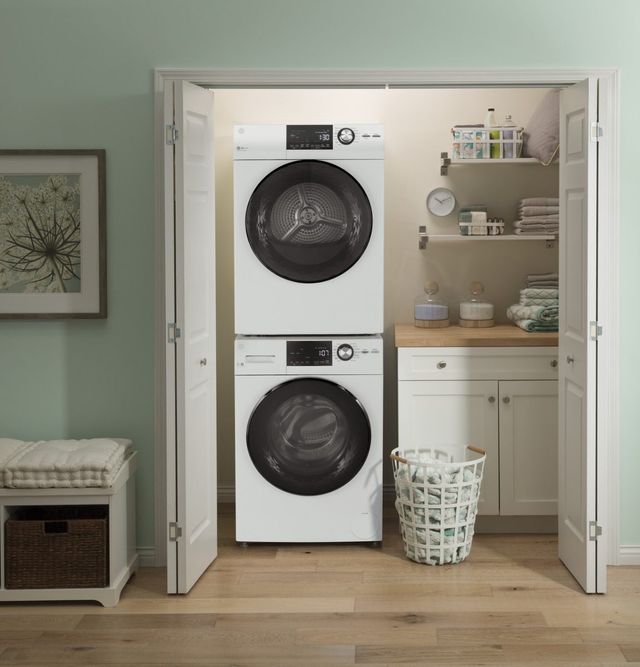
Numbers before shopping. Measure in a fixed order so nothing gets skipped, starting with the closet or alcove width, then total available height, then depth from the back wall to the closed door, then the door swing arc and the delivery path.
Stacked height is simple math that people still get wrong. Washer height plus dryer height plus the stacking kit allowance equals the column height. Compact 24-inch pairs typically land near 67 to 70 inches stacked. Full-size 27-inch pairs commonly reach 76 to 80 inches. Two follow-up questions matter as much as the total: can the primary laundry user actually reach the dryer control panel and lint filter at that height, and does a wire shelf or upper cabinet have to come out first? Removing a shelf before delivery costs almost nothing. Discovering the problem while a dryer sits on your driveway costs a redelivery.
Clearances That Get Overlooked
Cabinet dimensions are not installation dimensions. Build in the extra room the connections need.
- Leave roughly 5 inches behind the units for supply hoses, the condensate drain hose, and the power cord without crushing anything.
- Leave about 1 inch on each side so the cabinets are not wedged into the framing, which transmits vibration straight into the wall.
- Confirm the closet doors provide air openings at the top and bottom. Louvered or vented bifold doors exist for this reason, and a sealed closet lets a ventless dryer recirculate its own warm exhaust, which stretches cycle times.
Depth deserves an honest measurement too. Measure with the door open, not just the cabinet depth, because a front-load door swings 20 to 24 inches out and can block the closet threshold or a narrow hallway entirely.
Your Measuring Checklist
- 1. Measure closet width at the floor, at 40 inches up, and near the top, since walls are rarely square.
- 2. Measure floor to ceiling, and floor to the bottom of any shelf, soffit, or cabinet.
- 3. Measure depth from the back wall to the face of the closed door, then note where hookups sit.
- 4. Measure the door opening with the door in its open position, not the rough framing.
- 5. Add the washer height, dryer height, and stacking kit allowance to get true stacked height.
- 6. Note the outlet type, the drain standpipe height, and whether the floor is level.
Here is the step almost nobody takes and everybody should. Photograph and measure the entire delivery path, including the front door, the narrowest hallway, the 90-degree turn at the top of the staircase, and the closet door frame itself. A dryer that fits the closet but not the stairwell turn is still a failed delivery.
Get Power and Water Right Before Delivery Day
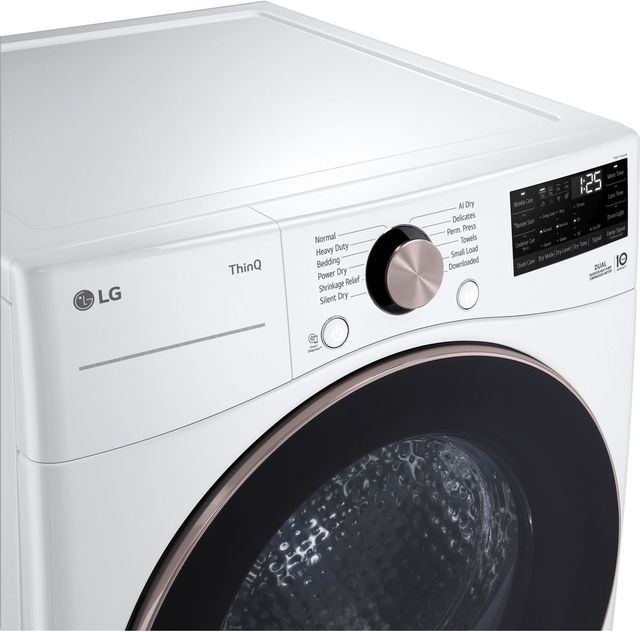
The electrical side is where a ventless dryer either becomes easy or becomes an electrician’s appointment. Most compact 24-inch heat pump dryers operate on a standard 120-volt household outlet, which is exactly what makes them workable in apartments and older DFW condos that never had a dryer circuit. Full-size ventless models usually need a dedicated 240-volt receptacle. Confirm the amperage and receptacle type on the model spec sheet rather than assuming, and use a licensed electrician for any new circuit.
Drain Hose or Reservoir
Every ventless dryer produces water, and you get two ways to deal with it. A gravity drain hose routes the condensate into the washer standpipe or a laundry sink and you never think about it again. An internal reservoir holds the water until you empty it after each load.
In a stacked setup the drain hose is nearly always the better choice. A reservoir on a top-mounted dryer sits at chest height or higher, emptying it every load gets tiresome fast, and a full tank will pause the cycle and leave you with damp clothes.
There is a wrinkle almost no one spells out. When the dryer sits above the washer, the drain hose runs downhill from the dryer into the standpipe, so standpipe height, hose length, and any anti-siphon requirement have to be checked against the manufacturer’s installation instructions and local plumbing code before the stack goes up.
Why Room Temperature Matters in Texas
A heat pump dryer pulls heat out of the air around it. That makes location a performance issue, not just a convenience one. Put one in an unconditioned Arlington garage in August and it is working against 105-degree intake air. Put it in the same garage during a January cold snap and it slows down for the opposite reason.
This is the one number our installers check before they will sign off on a garage location: heat pump dryer manuals commonly specify an ambient operating range of roughly 41 to 95 degrees Fahrenheit, and running outside that band means longer cycles, damp loads, and in some cases an error code rather than a warranty claim. An indoor, climate-controlled closet or laundry room is the right spot.
There is a genuine upside to the same physics. Unlike a vented dryer, a ventless model does not pump air you already paid to cool out through a wall, so it is not fighting your air conditioner every load during a North Texas summer.
For a second-floor or closet install, add three practical items: a drain pan under the washer, a floor checked for level so a tall stack stays stable, and accessible shutoff valves for both hot and cold supply lines.
Run this pre-delivery list before the truck is scheduled:
- Outlet type and amperage verified against the spec sheet
- Water supply valves and shutoffs reachable behind the stack
- Standpipe or drain confirmed for the condensate hose
- Floor level checked and shimmed if needed
- Closet doors provide top and bottom air openings
- Stacked height cleared, with shelving removed if it interferes
Match the Right Kit to the Right Pair So Your Stack Stays Safe
Start with the rule that governs everything else. A ventless dryer stackable washer setup requires a manufacturer-approved stacking kit made for that specific washer and dryer pairing. Stacking mismatched machines, or stacking with straps and a plywood shim, risks the dryer walking off the washer during a high-speed spin and can void the warranty on both units.
A stacking kit does three jobs. It mechanically ties the dryer cabinet to the washer cabinet, it manages vibration transfer between the two, and it sets the correct spacing so nothing binds. Part numbers matter more here than shoppers expect. Some heat pump dryers use a kit specific to heat pump models rather than the brand’s general compact stacking kit, and the wrong box does not bolt up.
Compatibility Rules People Get Wrong
- Only front-load washers can be stacked. A top-load lid opens upward, so nothing sits above it.
- The washer and dryer generally need to share a width and usually a brand family, because the brackets are cut for specific cabinet geometry.
- A compact 24-inch dryer should not be stacked on a 27-inch washer even though it physically sits there. The bracket footprint and the load path are wrong.
- The washer always goes on the bottom. It is heavier and it generates the spin forces the kit is designed to control.
- Reverse the dryer door if needed so it opens away from the closet wall instead of into it.
It also helps to know when stacking is not the best answer. A factory-integrated laundry tower puts both control panels at chest height in one purpose-built column, which solves the reach problem but removes the ability to replace one machine or mix brands. A side-by-side pair on pedestals gives you a folding surface and easy loading, but it needs roughly 54 inches of wall. A stacked pair with a kit is the right call when width is the constraint, when you want independent machines, and when you may want to swap one of them in eight years.
Our installers confirm kit compatibility before delivery and secure the stack on site, which is a meaningful difference from a big-box drop-off where two machines get left in the garage and the bracket box is your problem.
What you gain from a stacked ventless setup is placement freedom and a real cut in energy use per load. What you give up is time and, on compact models, drum size. Both sides are worth understanding before you commit, because the trade-offs show up every single laundry day rather than once at purchase.
Pros
Installs where nothing else can:
With no duct and no exterior wall penetration required, an interior closet, a half bath, a hallway alcove, or a second-floor landing becomes a viable laundry location.
Recovers floor space:
Going vertical takes a laundry footprint from roughly 54 inches of wall down to 24 or 27 inches, which frees the rest of the closet for shelving or storage.
Roughly half the energy per load:
A heat pump dryer commonly uses around 1.7 kWh per load against about 3.4 kWh for a standard vented electric dryer, and that gap compounds across a decade of laundry.
Gentler on fabric:
Lower drying temperatures are easier on knits, activewear, and technical fabrics that shrink, pill, or lose stretch under high vented heat.
No conditioned air sent outside:
During a DFW summer a vented dryer pulls cooled air out of the house and hot air in through every gap, and a ventless dryer simply does not do that.
No lint duct to worry about:
There is no exterior duct run to clean and no clogged vent line quietly becoming a fire risk behind the wall.
Cons
Longer cycles and smaller compact drums:
A heat pump cycle typically runs 15 to 40 minutes longer than a vented cycle, and a 4.0 cubic foot compact drum means more loads for a family than a 7.4 cubic foot full-size drum.
Higher upfront price and real maintenance:
Ventless models cost more to buy, and the secondary condenser or evaporator filter has to be rinsed on schedule or cycle times climb and efficiency drops.
Read more:
The Buying Criteria That Actually Matter in a Small Laundry Space
Once the space and the power are settled, the decision comes down to a handful of variables. Work them in this order.
Capacity Versus Space
A compact 24-inch model in the 4.0 to 4.3 cubic foot range genuinely serves one or two people, an apartment household, or a secondary upstairs laundry. A family washing bedding and bath towels every week needs a full-size 27-inch ventless model in the 7.2 to 7.8 cubic foot range, because the alternative is splitting every comforter into two cycles.
Cycle Time Against Household Volume
This is the trade-off to settle before you look at price. A heat pump dryer that runs 20 minutes longer per load is invisible to a two-person household running three loads a week. For a family running four loads on a Saturday, that same 20 minutes becomes more than an hour of added laundry day. Match the technology to your volume first, then shop capacity.
Controls, Sensors, and Noise
Moisture sensor drying stops the cycle when the clothes are dry instead of running a fixed timer, which protects fabric and saves energy. Steam or wrinkle-refresh cycles rescue a load that sat in the drum. A reversible door, an interior drum light, and a stainless drum all pay off in a dark closet. Wi-Fi cycle notifications matter more on a ventless dryer than a vented one, simply because the cycles run longer. And check the decibel rating when the laundry closet shares a wall with a bedroom or living room, since the dryer will be at ear level in a stack.
Efficiency Ratings You Can Verify
Look for ENERGY STAR certification, and for the ENERGY STAR Most Efficient designation on the top performers. Then compare Combined Energy Factor on the spec sheet instead of trusting marketing language. That number is what turns the 1.7 kWh against 3.4 kWh comparison from earlier into a figure you can hold two models against.
Brands and Service Coverage
A DFW shopper comparing ventless laundry will run into LG, Bosch, Miele, Samsung, GE and GE Profile, Whirlpool, Electrolux, Asko, and Midea. All of them build compact or full-size front load laundry worth considering. Service availability belongs in the decision too, because heat pump drying is newer technology and not every retailer can actually service it. Ask who fixes it before you ask what it costs.
Keep Your Stack Running Efficiently for Years
A stacked column is an assembly holding a machine that spins at over 1,000 RPM, so the install sequence is not optional.
- 1. Position the washer and level it on all four feet, since a slight rock at floor level becomes a real wobble four feet up.
- 2. Remove the washer shipping bolts before anything goes on top of it.
- 3. Attach the stacking kit brackets according to the kit instructions for that pairing.
- 4. Lift and seat the dryer squarely on the brackets.
- 5. Secure the dryer with the supplied fasteners at the specified placement.
- 6. Connect the condensate drain hose and route it without kinks.
- 7. Connect power and, if applicable, the water supply.
- 8. Reverse the dryer door if it needs to open away from the closet wall.
- 9. Run a full test cycle and check for drainage, drying, and vibration.
Be realistic about step four. A dryer has to be lifted to chest height or higher and set precisely on brackets you cannot see while lifting. That takes two capable people minimum, and it is the single most common reason buyers choose professional installation over a weekend project.
The Maintenance Routine
- Clean the primary lint filter after every load, without exceptions.
- Rinse or vacuum the secondary condenser or evaporator filter on the manufacturer’s schedule, often monthly.
- Empty the reservoir after each load if the dryer is not plumbed to a drain.
- Wipe the door seal and leave the door ajar so it dries out.
This matters more on a ventless dryer than on a vented one. A clogged secondary filter restricts the airflow the condensing process depends on, and the machine responds by running longer and using more electricity to reach the same dryness.
Symptom to Cause
- Clothes still damp at cycle end: usually an overloaded drum or a dirty secondary filter.
- Cycles running much longer than they used to: almost always the secondary filter, sometimes a room too cold for the heat pump.
- Water pooling under the unit: a kinked, blocked, or disconnected condensate drain hose.
- Error code for a full reservoir: the tank needs emptying or the drain hose option was never connected.
- Dryer walking or vibrating on top of the washer: an incorrectly installed stacking kit or an unlevel washer below.
- Musty smell in the drum: a door seal left closed and damp, or a condenser filter overdue for cleaning.
Add one Texas-specific habit. Hard water is common across much of the metroplex and it leaves mineral residue on the washer below, so running the washer’s tub clean cycle monthly supports the whole stack, not just the bottom half. Texas Appliance provides in-house service across the Arlington, Fort Worth, and Plano area, so warranty and repair work is handled by local technicians instead of a third-party call center queue.
The Drying Window Math That Decides Which Ventless Dryer You Should Buy
Cycle length gets discussed as a feeling instead of a number, and that is why people get surprised. Convert it into weekly hours and the answer becomes obvious. Count your loads per week, multiply by realistic cycle length, and compare the result to the hours the closet is actually available. A two-person household running three loads a week at 120 minutes per load spends six hours drying, which fits easily into any week. A family of five running ten loads a week at that same 120 minutes spends 20 hours, and since the dryer cannot run two loads at once, laundry day stops being a day and becomes a weekend. Bigger drum capacity fixes this far more effectively than any efficiency setting, because fewer, fuller loads mean fewer total cycles.
- Three loads a week or fewer: a compact 24-inch heat pump dryer at 4.0 to 4.3 cubic feet is comfortable, and the longer cycle never becomes visible.
- Four to six loads a week: compact still works if you spread loads across weekdays, but a full-size ventless model removes the bottleneck.
- Seven or more loads a week: go full-size at 7.2 to 7.8 cubic feet, because every load you eliminate saves an entire cycle length.
- Overnight drying available: long heat pump cycles cost you nothing if the dryer runs while you sleep, so delayed start and quiet operation are worth paying for.
- Same-day turnaround required for uniforms or sports gear: keep a vented option on the list if a duct path exists, since vented cycles finish in 45 to 70 minutes.
- Laundry closet next to a bedroom: longer cycles mean more running hours near that wall, so weigh the decibel rating heavily.
Read more:
Shop Ventless Dryers Built to Stack, In Stock at Texas Appliance
The lineup below covers the realistic paths through this decision, from 24-inch compact ventless dryers for an apartment closet to full-size ventless models for a family replacing a vented pair. The last three picks are the comparison options for readers who discovered they do have a workable duct path, and their product names do not identify them as ventless, so confirm the venting requirement on each product page before ordering. Every model can be opened, measured, and compared in person in a Texas Appliance showroom, with delivery and professional installation available across the Dallas–Fort Worth metroplex.
Bosch 300 Series 24” White Front Load Electric Dryer
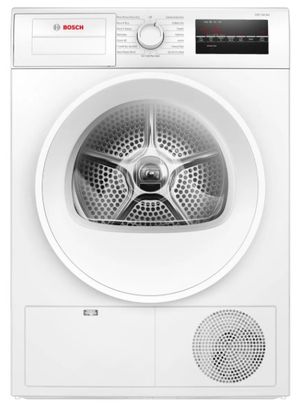
Apartment and condo closets measuring 25 or 26 inches across are where this 24-inch Bosch belongs. It sits in the compact 300 Series laundry line, which dries without a duct by condensing moisture out of recirculated air, so an interior closet with no exterior wall stops being a dead end. Stacked on the matching 24-inch Bosch washer with the brand’s approved kit, the finished column stays in the 67 to 70 inch range described earlier. Confirm the outlet type and drain routing on the product page, then let our installers lift and secure the stack correctly.
Top Features
- True 24-inch cabinet: Fits narrow laundry closets and alcoves where a 27-inch machine will never go.
- Ventless condensation drying: No exterior duct run required, which is what makes an interior closet workable.
- Built for a compact stack: Pairs with the matching Bosch compact washer using the brand’s approved stacking kit.
- Compact laundry footprint: Takes a two-appliance laundry down to roughly two feet of floor width.
Electrolux 4.0 Cu. Ft. White Front Load Ventless Compact Stackable Electric Dryer

For one or two people in a Dallas apartment or a Fort Worth condo, this compact Electrolux is the direct answer. The name states the parts that matter, ventless, compact, and stackable, with 4.0 cubic feet of drum inside a 24-inch cabinet. Because there is no duct to route, it installs anywhere the power and drain reach, which is the whole argument for a ventless dryer stackable washer column. Pair it with the matching Electrolux compact front load washer and the brand stacking kit, and the finished laundry occupies about two feet of wall.
Top Features
- Ventless by design: Condenses moisture internally rather than exhausting humid air outdoors through a duct.
- 4.0 cubic foot capacity: Sized right for one or two people without wasting energy on half-empty loads.
- Factory stackable: Built to pair with the matching Electrolux compact washer and approved stacking kit.
- 24-inch width: Clears the tight closet openings common in older DFW apartments and condos.
Whirlpool 7.4 Cu. Ft. White Front Load Ventless Electric Dryer

Families replacing an aging vented pair without cutting new ductwork should start right here. At 7.4 cubic feet this Whirlpool is a full-size ventless dryer, so towels, jeans, and a queen comforter go in together instead of getting split across two cycles. Full-size ventless models generally call for a dedicated 240-volt circuit, so verify the receptacle listed on the product page before delivery day. Stacking works with the approved Whirlpool kit on a matching front load washer, which makes this the pick for a closet that has the power but never had a good vent path.
Top Features
- Full-size 7.4 cubic foot drum: Handles bedding and family loads without dividing them into two cycles.
- Ventless operation: Removes the exterior duct requirement while keeping full-size capacity.
- Stack-ready with the approved kit: Mounts above a matching Whirlpool front load washer for a single-column laundry.
- Straight replacement path: Suited to homes that already have a dedicated laundry circuit in place.
LG 7.8 Cu. Ft. White Ventless Electric Dryer with Dual Inverter HeatPump Technology and Wi-Fi Connectivity
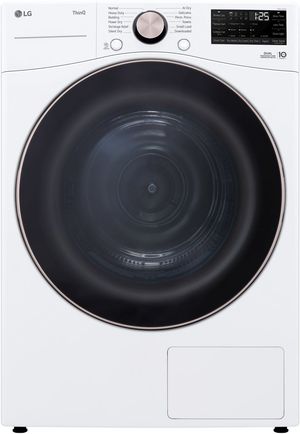
A busy household that wants full capacity and the lowest energy use per load lands on this one. LG pairs 7.8 cubic feet with dual inverter heat pump drying, which recycles its own heat instead of throwing it outdoors, and that is exactly where the roughly half-the-energy figure covered earlier comes from. Wi-Fi cycle alerts earn their place on a heat pump dryer, since cycles run longer and a phone notification beats standing at the closet door. Confirm the circuit requirement, then plan the condensate drain down to the washer standpipe below.
Top Features
- Dual inverter heat pump: Recycles heat inside the cabinet for the lowest energy use per load in this lineup.
- 7.8 cubic foot capacity: Full-size drum for comforters, towels, and multi-person households.
- Wi-Fi cycle notifications: Alerts your phone when a long heat pump cycle finishes, so loads do not sit damp.
- Ventless installation: No duct, no exterior wall penetration, no conditioned air pushed outside in summer.
Asko 3 Series 4.2 Cu. Ft. White Ventless Electric Dryer
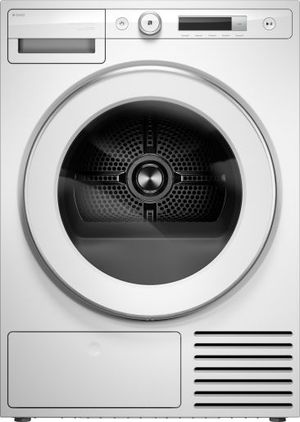
Wool, knits, and technical activewear are the reason this Asko is on the list. The 3 Series ventless design dries at lower temperatures than a vented drum, which is gentler on the fabrics that shrink or pill under high heat, and 4.2 cubic feet inside a compact cabinet keeps it closet-friendly. European compact laundry was built around exactly the situation described earlier, no duct, limited width, stacked column. Verify the stacking kit part number for the matching Asko washer, and our team will confirm the finished stack height against your closet opening first.
Top Features
- Low-temperature ventless drying: Protects knits, wool, and performance fabrics that high vented heat damages.
- 4.2 cubic foot compact drum: Real capacity in a cabinet built for narrow laundry closets.
- Premium fabric care programs: Purpose-built cycles for delicates rather than one generic heavy-duty setting.
- Designed to stack: Mounts above a matching Asko washer with the correct manufacturer kit.
GE 4.3 Cu. Ft. White Front Load Electric Dryer with Stainless Steel Basket
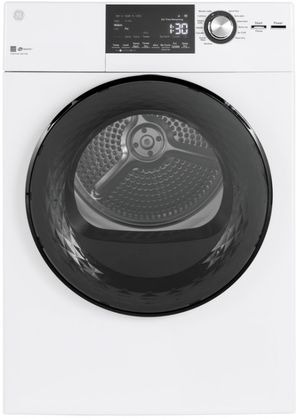
Plenty of readers reach this point and realize they do have a usable duct path after all, which puts this compact GE back in play. It is listed simply as a front load electric dryer with a stainless steel basket, not as a ventless model, so plan on venting and confirm the exact requirement on the product page before ordering. A vented dryer needs an exterior duct run, and no workaround changes that. What you get in return is the shorter cycle length from the comparison table and a stainless basket that will not snag fabric.
Top Features
- 4.3 cubic foot capacity: Compact-column capacity that suits a closet or a smaller household.
- Stainless steel basket: Smooth, durable drum surface that resists chipping and will not catch delicate fabrics.
- Faster cycle times: A vented cycle finishes well ahead of a comparable heat pump cycle.
- Confirm venting first: Check the product page specifications, since this model is not designated as ventless.
Midea 4.4 Cu. Ft. White Front Load Electric Dryer
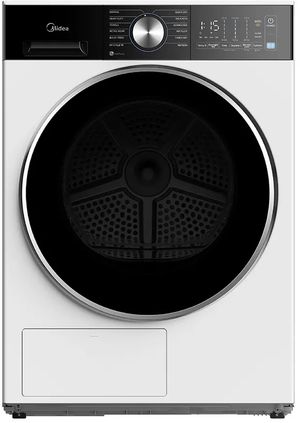
Value-focused shoppers who already have a duct stub in the closet wall should look at this Midea. Its product name identifies it as a 4.4 cubic foot front load electric dryer with no ventless designation, so plan on an exterior duct run and confirm both the venting and the outlet requirements on the product page before you buy. Stacked above a matching Midea front load washer with the approved kit, it builds a narrow laundry column at a lower entry price than heat pump technology. Our team can tell you which pairing that kit actually covers.
Top Features
- 4.4 cubic foot drum: Slightly more room than most compact models in the same cabinet width.
- Lower entry price: A budget-friendly path to a stacked laundry column where a duct already exists.
- Front load stacking design: Mounts above a matching Midea front load washer with the correct kit.
- Verify the vent requirement: The product page specifications confirm what this model needs before delivery.
Samsung 4 Cu. Ft. White Front Load Electric Dryer
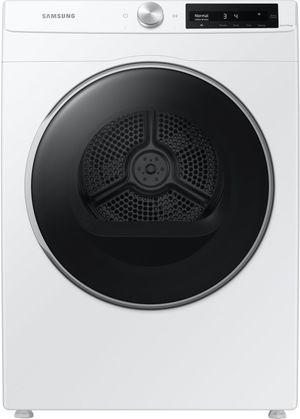
Rounding out the comparison picks, this Samsung front load dryer suits a closet that already has both a duct path and the right receptacle. The 4 cubic foot drum fits a compact column, and like the two models above it is not named as a ventless dryer, so confirm the venting requirement on the product page rather than assuming it runs duct-free. Where a vent already exists, a vented cycle finishes faster than a heat pump cycle, which is the exact trade-off laid out in the drying window math above. Ask our team to verify kit compatibility.
Top Features
- 4 cubic foot capacity: Fits a compact stacked column in a standard laundry closet.
- Front load design: Stacks above a matching front load washer with the manufacturer-approved kit.
- Quick turnaround: Vented drying returns same-day loads faster than low-temperature heat pump cycles.
- Check the specifications: Not designated ventless, so verify the duct requirement on the product page first.
Ready to Stack? Build Your Ventless Dryer Stackable Washer Setup With Texas Appliance
Confirmed measurements and true stacked height, the right voltage, a planned drain path, and a manufacturer-approved stacking kit are what turn a tight closet into a working laundry room. From there, match capacity and cycle time to how much laundry your household actually runs, and the model choice narrows itself down fast. Get those four things right and the rest is just picking a finish.
Ready to see them side by side? Shop ventless dryers and stackable laundry pairs at Texas Appliance online, or visit a showroom in Arlington, Fort Worth, or the Plano area and bring your closet numbers with you. Our team will run a fit check before you spend a dollar, our own delivery crews install and secure the stack the way the manufacturer specifies, and our in-house service department is local years down the road. That is the difference between buying from an independent Dallas–Fort Worth retailer and clicking a button at a warehouse.
Frequently Asked Questions About Ventless Dryer Stackable Washer Setups
Yes, a ventless dryer can be stacked on top of a compatible front load washer as long as you use the manufacturer-approved stacking kit for that exact pairing. The washer always goes on the bottom because it is heavier and it generates the spin forces the brackets are designed to control.
Both are ventless, but a condenser dryer cools the moist air with a second air stream and discards that heat, while a heat pump dryer uses a refrigerant loop to recycle the heat back into the drum. The heat pump approach uses roughly half the energy per load and dries at lower temperatures, which is why nearly every new ventless model on the market is a heat pump.
Most ventless dryers give you both options, a gravity drain hose routed to the washer standpipe or a laundry sink, or an internal reservoir you empty after each load. In a stacked column the drain hose is the better choice, because a tank mounted at chest height is awkward to empty and a full reservoir will pause the cycle.
A ventless heat pump dryer typically runs 90 to 150 minutes for a normal load, which is roughly 15 to 40 minutes longer than a comparable vented cycle. The extra time comes from drying at a lower temperature, and that is the direct trade for using about half the electricity per load.
Many compact 24-inch ventless dryers run on a standard 120-volt, 15-amp household outlet, while most full-size ventless models require a dedicated 240-volt circuit. Check the spec sheet for the exact model before ordering, because the receptacle already sitting in the closet is the single biggest install blocker.
The real downsides are longer cycle times, smaller drum capacity on compact models, a higher purchase price, and a secondary condenser filter that has to be cleaned on schedule. Heat pump performance also depends on the temperature of the room around it, so an unconditioned garage during a Texas summer is the wrong place for one.
Why Trust Texas Appliance?
With roots back to the 1950s, Texas Appliance is an established, locally owned and operated, residential major appliance retailer serving both residential and builders’ needs. Our 4 locations allow us to offer a full spectrum of appliances to meet your every need. With over 40 major quality brands, Texas Appliance has one of the largest displays of built–in and free–standing appliances in the state of Texas.
We will be the best appliance dealer in our markets by exceeding our customers' expectations in every way. We will treat our customers, vendors and fellow employees with respect, honesty, integrity and appreciation. The difference between a "Good" company and a "Great" company lies in its' employees' determination.
Shop Ventless Dryers at Texas Appliance
Stop by Texas Appliance’s Fort Worth Store and Outlet locations to see what a difference buying local with an experienced staff can make. Or shop Mattresses online! Our friendly experts are always happy to help you find the best Sealy mattresses for your bedroom — whether you call us at 817-299-2800, use our online chat feature, or visit us in person.