

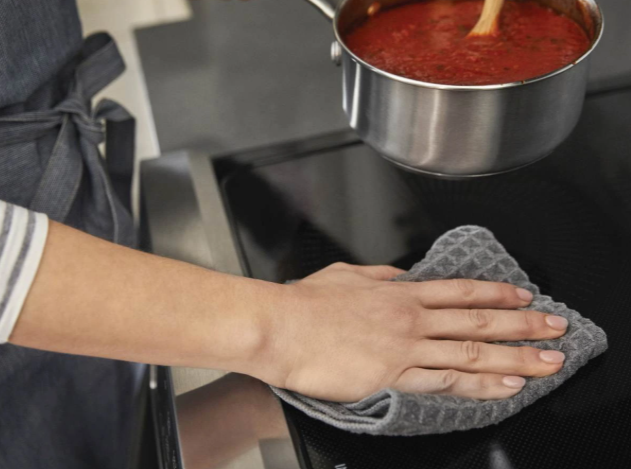
The gas range in a Richardson kitchen finally quits halfway through a holiday dinner, and by Saturday morning the homeowner is standing in a showroom aisle with a tape measure in one hand and a phone in the other. On the other end of the phone is a brother-in-law with opinions. Every pot in the house has to go in the trash, he says. The wall has to come open for new wiring. Real cooks use flame. So the shopper leaves without buying anything, still working around two dead burners at home, because three confident sentences from a relative outweighed everything printed on the spec sheets. That is how most people first meet induction stoves, secondhand and mostly wrong.
The reality is far simpler than the rumor mill makes it sound. At Texas Appliance, our team walks Dallas–Fort Worth shoppers through this decision constantly, and almost every hesitation traces back to one of the same seven pieces of bad information. This guide takes those seven apart one at a time, covering cookware you probably already own, what your electrical panel actually needs, the real purchase and operating cost, how induction stacks up against a high-BTU gas burner, glass durability and burn risk, pacemakers and electromagnetic fields, and why some cooktops hum. Along the way you get a comparison table, a buying checklist, and the specific models worth seeing in person.
See Induction Cooking in Person Before You Believe the Rumors
Our team compares induction ranges and cooktops with Dallas–Fort Worth shoppers every week, from 30-inch slide-ins to 48-inch pro style models. Shop brands side by side, get a straight answer on your electrical panel, and have it installed and serviced by people who live here.
Explore induction stovesKey Takeaways
- The magnet test settles the cookware question in ten seconds: If a refrigerator magnet grips the bottom of a pan firmly, that pan works on induction, and most kitchens already own cast iron, carbon steel, and magnetic stainless pieces that qualify.
- Wiring is only a project for gas households: A home already running an electric range usually has the 240-volt circuit induction needs, while a gas-to-induction conversion means a new circuit run and a capped gas line.
- Efficiency shows up twice in a Texas summer: Induction puts roughly 85 to 90 percent of its energy into the pan instead of the room, so the kitchen stays cooler and the air conditioner works less during July and August.
- Noise is information, not a defect: A low hum at high power and a running cooling fan are normal, while crackling almost always points to a warped or poorly bonded pan rather than a failing cooktop.
How Induction Stoves Actually Work: The Science Behind the Confusion
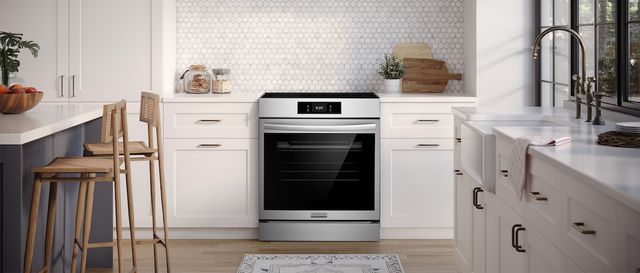
Under the ceramic glass surface of an induction cooktop sits a coil of copper wire. Send alternating current through that coil and it creates a rapidly switching electromagnetic field just above the glass. Set a pan with a ferromagnetic base into that field and the field induces electrical currents inside the metal itself. Those currents meet resistance, resistance makes heat, and the pan becomes the burner. The glass underneath never had to get hot to make that happen.
That single difference explains almost everything else. A gas burner makes a flame that heats the air, the pan bottom, the pan sides, the grate, and the whole room around it. An electric radiant element heats a coil under the glass, the coil heats the glass, and the glass heats the pan. Both approaches route energy through a middle step. Induction skips the middle step entirely and hands energy straight to the metal.
The efficiency numbers follow from that. Commonly published figures put induction energy transfer around 85 to 90 percent, electric radiant somewhere in the 70s, and gas closer to 35 to 65 percent depending on the burner and the pan. Treat those as typical published ranges rather than a guarantee for a specific model, because pan material, base thickness, and burner design all move the number.
Induction Is Not a Microwave
This confusion sends more shoppers down the wrong path than any other. A microwave oven pushes energy into the food, exciting water molecules throughout whatever is on the plate. Induction never touches the food. The field acts on the pan, the pan conducts heat into the food the same way it always has, and that is exactly why induction sears a steak, browns a roux, and reduces a pan sauce properly while a microwave cannot.
A few terms are worth knowing before the myths start falling:
- Ceramic glass surface: the flat cooking top, rated for thermal shock rather than ordinary tempered glass.
- Induction coil: the copper element under the glass that generates the field.
- Ferromagnetic cookware: cast iron, carbon steel, and magnetic stainless steel bases that respond to the field.
- Residual heat indicator: a light that stays lit while the glass is still warm from the pan.
- Bridge element: two zones linked into one long cooking area for griddles and roasting pans.
- Power boost: a temporary surge of extra output on one element for fast boiling.
Nearly every myth ahead comes from mistaking induction stoves for electric radiant cooktops or for microwave cooking. Once the mechanism is clear, the rest falls apart quickly.
Read more:
Must-Have Features to Look for in an Induction Cooktop
Induction vs Electric Cooktops: Which Is Better for Your Kitchen?
Myth 1: You Have to Replace Every Pot and Pan You Own
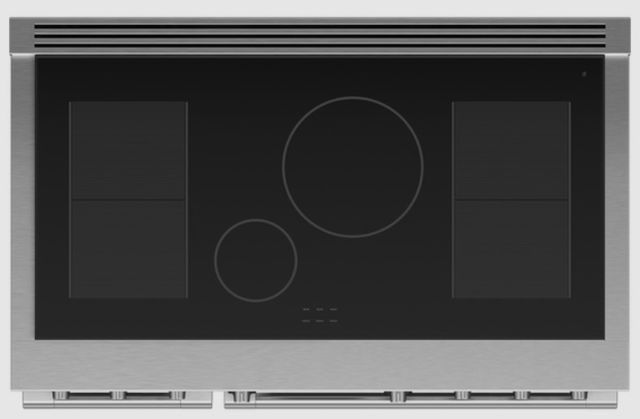
Only the base of the pan has to be ferromagnetic. Not the sides, not the handle, not the brand. Most kitchens in North Texas already contain three or four qualifying pieces sitting in the cabinet right now, usually a cast iron skillet, a stainless stockpot, and a clad sauté pan with a magnetic disc bonded to the bottom.
The 10-Second Magnet Test
Take a refrigerator magnet. Press it against the bottom of the pan. If it grips firmly and takes a little effort to pull off, the pan works on induction. If it slides off or barely tacks, it does not.
Run that test across your whole cabinet before you shop. It takes about two minutes and it turns an abstract worry into a short shopping list.
Here is how the categories usually sort out:
- Works reliably: cast iron, enameled cast iron, carbon steel, magnetic stainless steel, and clad pans with a magnetic disc base.
- Does not work: pure aluminum, pure copper, glass and ceramic bakeware, and most non-magnetic stainless alloys.
- Depends on the piece: some stainless sets use a magnetic base under a non-magnetic body, which is why the magnet decides and the label does not.
Flatness and Diameter Matter as Much as Material
This is the part most articles skip. A pan can pass the magnet test and still perform badly. A warped or convex base only touches the glass in a ring, which produces uneven heating, slower response, and more audible vibration. Older aluminum-core pans that have been through years of high gas heat are the usual offenders.
Base diameter matters too. Most cooktops need a minimum base size, often somewhere around 4 to 4.7 inches, before pan detection recognizes anything is there. A tiny butter warmer may simply never trigger the element. Check the minimum pan diameter on the spec sheet if you cook with small pans.
Interface discs exist as a workaround. They are a ferromagnetic plate you set on the element with a non-magnetic pan on top. They work, and they also throw away most of induction’s responsiveness, because you are back to heating a plate that heats a pan. Use one for a favorite copper piece, not as a strategy for the whole kitchen.
On cost, the honest framing is filling gaps rather than replacing a kitchen. Most households end up buying one or two pieces, commonly a large skillet or a specific saucepan, and a solid replacement pan typically runs somewhere in the $40 to $150 range depending on brand and construction.
Myth 2: Induction Cannot Match Gas for Power, Heat, or Precision
The performance argument is the one that collapses fastest under real numbers. High-output induction elements commonly land in the 3,700 to 7,400 watt range with boost engaged, and published boil tests routinely show a large pot of water reaching a rolling boil in a few minutes on a high-power induction element while a high-BTU gas burner needs well over ten minutes for the same volume. The energy is going into the water instead of up the sides of the pot and into the room.
Two features do the heavy lifting at the top end. Power boost temporarily borrows extra output for one element, which is what makes canning, pasta water, and stock pots fast. Bridge elements link two zones into one continuous surface so a griddle or a long roasting pan heats evenly instead of in two hot spots.
The low end is where induction quietly wins and competitors rarely mention it. Output steps down electronically instead of relying on a physical flame that gets unstable when you choke it back. That means melted chocolate that does not seize, a custard that holds without a double boiler, and a reduction that stays at a bare shiver for twenty minutes without babysitting.
Where Gas Still Wins
Two exceptions are genuine and worth saying plainly. Open-flame charring, the kind that blackens a poblano directly over the burner, has no induction equivalent. Traditional round-bottom wok cooking also depends on flame wrapping up the sides of the wok. Some manufacturers now build dedicated concave induction wok elements, and flat-bottom wok cooking works well on a standard element, but a purist doing high-volume tossing over live fire should know the trade before buying.
There is one more advantage that matters more in Texas than almost anywhere else. Induction produces no combustion byproducts in the kitchen and dumps far less waste heat into the room. Cooking a full dinner on a gas range in August means the air conditioner spends the evening fighting your stove. Induction stoves simply do not create that fight, because the heat stays in the pan where you wanted it.
Induction vs Gas vs Electric Radiant: A Side-by-Side Reality Check
Read this table by finding the row that describes your actual constraint, then compare across. All figures are typical ranges and vary by brand and model.
| Feature | Induction | Gas | Electric Radiant |
|---|---|---|---|
| Heating method | Magnetic field heats the pan directly | Open flame heats pan and air | Coil heats glass, glass heats pan |
| Energy transfer efficiency | Roughly 85 to 90 percent | Roughly 35 to 65 percent | Roughly 70 to 75 percent |
| Time to boil a large pot of water | A few minutes on high power | Often more than ten minutes | Typically ten to fifteen minutes |
| Simmer and low-heat precision | Very fine, stepped electronically | Good, limited at very low flame | Slow and imprecise |
| Responsiveness to setting changes | Near instant | Fast | Slow to rise and slow to fall |
| Cookware requirements | Ferromagnetic base required | Any cookware | Any flat-bottom cookware |
| Surface temperature and burn risk | Warm only from residual pan heat | Open flame and hot grates | Element stays hot after shutoff |
| Ease of cleaning | Wipe a flat surface, spills rarely bake on | Grates and burner caps come off | Flat surface, spills bake on faster |
| Indoor air quality impact | No combustion byproducts | Produces combustion byproducts | No combustion byproducts |
| Utility connection required | Electric only | Gas line plus electric | Electric only |
| Typical circuit requirement | 240-volt, commonly 30 to 50 amps | 120-volt outlet plus gas | 240-volt, commonly 40 to 50 amps |
| Installation considerations | Circuit and panel capacity | Gas line and shutoff access | Circuit and cutout size |
| Kitchen heat output | Low | High | Moderate |
| Typical price range for a 30-inch unit | About $1,200 to $4,000 and up | About $700 to $3,500 and up | About $600 to $2,000 |
| Best suited for | Speed, precision, family safety | Open-flame and wok techniques | Lowest upfront cost |
Read practically, the table sorts into three buyers. High-volume home cooks and families with young children get the most from induction, because they benefit from both the speed and the cool surface. Wok purists and anyone who chars vegetables over live flame have a real reason to stay with gas. Budget-driven replacements where the existing electric range died and the goal is a working stove for the least money still point to electric radiant.
Myth 3: Switching to Induction Means Rewiring Your Whole House
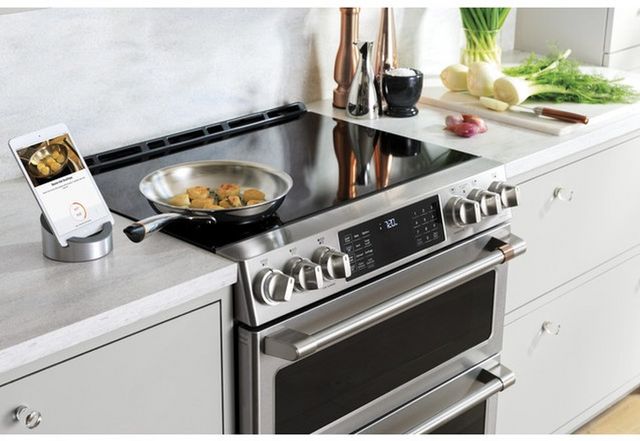
Here is the actual requirement. Most full-size induction cooktops and induction ranges need a dedicated 240-volt circuit, commonly rated somewhere between 30 and 50 amps depending on total wattage. The model’s spec sheet dictates the exact breaker size and wire gauge, and that document is the only source worth trusting for a specific unit.
Now the distinction that changes everything for most readers. If your kitchen already has an electric range, the correct circuit is almost certainly already there. Swapping an electric radiant range for an induction range is usually a straight replacement, occasionally with a breaker change. The house that needs real work is the house converting from gas.
What a Gas-to-Induction Conversion Involves
A gas conversion in an older DFW home typically means three things:
- 1. A licensed electrician runs a new 240-volt circuit from the panel to the range location.
- 2. The panel gets evaluated for available capacity and open breaker space, which is the step that surprises people in homes built with 100-amp service.
- 3. A plumber caps the existing gas line safely and the connection is left accessible per code.
Costs vary widely, and anyone quoting a single number is guessing. Depending on panel location, the distance of the run, whether walls or a slab are in the way, and local permitting, most conversions land somewhere in the several hundred to a few thousand dollar range. A panel upgrade pushes the top of that considerably. Home age is the biggest variable across the metroplex, since a 1960s Fort Worth ranch and a 2015 Frisco build are entirely different jobs.
Lower-Barrier Options That Actually Exist
Not every path requires an electrician. Portable single-zone and double-zone induction hobs plug into a standard 120-volt outlet and cost less than a decent skillet, which makes them a legitimate way to test the technology in an apartment or a rental. A small number of slide-in models are designed to work on a 30-amp circuit, which can matter when panel capacity is tight.
One trade-off deserves an honest mention. Some cooktops share a power supply between paired elements, so pushing two linked elements to maximum at the same time can reduce output on one of them. It rarely affects everyday cooking, but if you routinely run two large pots at full tilt, ask about power sharing before you buy.
Our team at Texas Appliance handles pre-purchase electrical assessment and professional appliance installation across Dallas–Fort Worth, so you find out what your kitchen needs before the order is placed, not after a truck arrives.
Myth 4: Induction Stoves Are Too Expensive to Buy and Operate
This myth blends three separate costs into one vague feeling. Take them apart.
Purchase price first. Portable single-zone units start under $100. Mainstream 30-inch induction cooktops and slide-in induction ranges generally run about $1,200 to $2,500. Premium and pro style models climb from there into the $4,000 to $10,000 range for wide 36-inch and 48-inch configurations. The important part is that induction pricing now overlaps heavily with comparable gas models at the same feature tier. Ten years ago induction carried a real premium. Today the gap at the mainstream tier is small enough that features, not fuel type, usually decide the purchase.
Installation is the second cost, and it splits exactly along the line drawn in the previous section. Electric-to-induction is minimal. Gas-to-induction carries the electrical work described above.
Operating cost is the third, and it favors induction. Putting 85 to 90 percent of the energy into the pan instead of 35 to 65 percent means less energy purchased per meal, though the exact dollar comparison depends on local electricity and natural gas rates. The saving competitors forget is the cooling load. Every unit of heat a gas burner throws into your kitchen in July is a unit your air conditioner has to remove, and that shows up on the same electric bill.
Rebates are worth checking and not worth quoting. Federal energy efficiency programs and utility company incentives for electric cooking appliances change frequently and vary by provider and by household eligibility. Look up current programs for your address rather than trusting a figure printed in an article.
Total cost of ownership rounds it out. An induction cooktop has no igniters, no burner caps, no grates warping under a stockpot, and no gas line to maintain. Cleaning takes a cloth instead of disassembly. Fewer moving parts means fewer service calls over a decade of use.
At Texas Appliance, financing options, seasonal promotions, and kitchen appliance packages are all part of the conversation, and bundling a range with other kitchen appliances is often where the math improves most.
Myth 5: Glass Induction Surfaces Crack Easily and Cause More Burns
This one is really two myths wearing the same coat. Take durability first, then burn risk.
The Glass Is Not Window Glass
Induction cooktops use ceramic glass engineered for thermal shock and impact resistance, not ordinary tempered glass. Manufacturers test it with dropped-weight and impact procedures because they know cookware gets set down hard in a real kitchen. Cracks happen, but they come from specific causes rather than normal cooking.
Practical care beats worry:
- Lift cast iron instead of dragging it, since a rough sand-cast bottom is the most common scratch source.
- Keep the surface out of service as a landing zone for grocery bags, cutting boards, and hot casserole dishes straight from the oven.
- Clean with a dedicated ceramic cooktop cream and a nonabrasive pad rather than a scouring sponge.
- Wipe sugary spills promptly, because sugar is the one spill that can pit the surface if it bakes on.
Burn Risk Actually Drops
The glass over an induction element only warms from residual heat conducted out of the pan sitting on it. Lift the pan and the element stops producing output immediately, which is a meaningful difference from a radiant coil that stays glowing for minutes. Residual heat indicators light up whenever the surface is still warm, and pan detection, auto shutoff, boil-dry protection, and child locks are standard on most current models.
Then there is the factor households with children or older adults care about most. No open flame means no ignition source for a loose sleeve, a dish towel, a paper towel roll, or a grocery bag set down in the wrong spot.
Two honest caveats keep this credible. Spills left on a warm surface can still bake on and need real scrubbing. A screaming-hot pan set back down on the glass still transfers heat into it, so the surface is not always cool just because the element is off. Come feel a running cooktop during a live cooking demonstration at a Texas Appliance showroom and the difference registers in about five seconds.
Myth 6: Induction Stoves Are Dangerous for Pacemakers and Emit Harmful Radiation
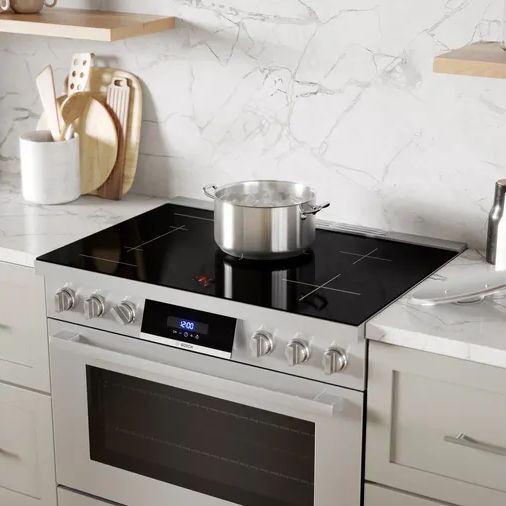
Induction stoves produce a low-frequency non-ionizing electromagnetic field, not ionizing radiation like a medical imaging scan or a nuclear source. Across decades of use in Europe and increasingly in the United States, there are no documented cases of an induction cooktop causing injury to a pacemaker patient.
The physics behind that record are straightforward. The field is tightly concentrated at the coil directly under the pan, and it falls off sharply with distance, dropping to a small fraction of its strength within roughly an inch or two above the surface. A properly seated ferromagnetic pan absorbs the great majority of the field, which is exactly what the system is designed to do. An uncovered element with no pan on it does not generate a working field at all, because pan detection keeps it idle.
Responsible guidance still applies, and thin content tends to skip it:
- Keep a modest distance between your body and the front edge of the cooktop while it is running.
- Center the pan on the element so the field is fully coupled rather than spilling past the pan edge.
- Avoid leaning your torso directly against the cooktop face during operation.
- Confirm with the device manufacturer or your cardiologist if you have an older implant or a unipolar configuration, which are the cases where guidance is most specific.
Cardiology and heart health organizations along with implant manufacturer support documentation are the right sources for a personal answer, and most of them publish clear position statements on household appliances including induction cooking. Bring the question to your care team rather than to a comment thread.
The adjacent worry belongs here too. Induction does not alter nutrients in food, does not make food radioactive, and does not change food chemistry in any way a gas flame does not. The food sits inside a metal pan, entirely outside the field, and only ever sees ordinary conducted heat.
Myth 7: Induction Cooktops Buzz, Hum, and Rattle Constantly
The complaint is not imaginary, and dismissing it is how people end up disappointed after delivery. Induction cooktops do make sounds. They come from three real sources: magnetostriction, which is the microscopic vibration of the layers in a multi-ply pan base as the field switches; the internal cooling fan that keeps the electronics at temperature; and brief clicking as the inverter steps power levels up or down.
Match the sound to the cause and the picture gets much less alarming:
- Low hum at high power: normal, and it comes from the pan, not the appliance.
- Steady fan whir: normal, and it continues briefly after cooking ends.
- Light clicking when changing settings: normal inverter behavior.
- Crackling or sizzling from the pan: usually a poorly bonded, riveted, or warped pan base.
- High-pitched whine with no pan on the element: not normal, and worth a service call.
How to Quiet It Down
Most noise complaints are cookware complaints. The fixes are simple:
- Use heavier, genuinely flat-bottomed pans instead of thin lightweight clad pieces.
- Keep the pan centered on the element and the base dry before it goes down.
- Drop off maximum boost once the water reaches a boil, since boost is where hum peaks.
- Match pan base diameter to element diameter rather than running a small pan on a large zone.
Here is the buying insight worth carrying into a showroom. Quiet operation correlates with better inverter design, higher-quality fans, and heavier overall construction. None of that appears on a spec sheet in a way you can compare. Standing in front of two running cooktops with a pot of water on each tells you more in thirty seconds than an hour of reading reviews. And if a whine or a fan fault does turn up later, Texas Appliance runs in-house service technicians locally, so diagnosis happens here instead of through a manufacturer call center queue.
Induction Stoves Pros and Cons: An Honest Look Before You Commit
With the myths cleared away, the real trade-offs are easier to see. Induction wins decisively on speed, control, cleaning, and kitchen comfort, and it asks for two things in return: qualifying cookware and the right circuit. Weigh both sides against how you actually cook rather than against how the technology sounds.
Pros
Fastest boil in the category
High-output elements with power boost bring a large pot to a rolling boil in a few minutes, well ahead of a high-BTU gas burner on the same volume.
True low-heat control
Electronic power stepping holds a bare simmer for chocolate, custard, and long reductions without the instability of a choked-down flame.
Cleanup is a wipe, not a project
One flat sealed surface with no grates, caps, or drip pans, and spills rarely bake on because the glass itself is not the heat source.
Safer around kids and older adults
Pan detection, auto shutoff, residual heat indicators, and child locks combine with the absence of an open flame to cut ignition and burn risk.
A cooler kitchen and cleaner air
No combustion byproducts indoors and far less waste heat, which is worth real money during a North Texas summer when the air conditioner is already working overtime.
Cons
Some cookware will not qualify
Aluminum, copper, and non-magnetic stainless pieces fail the magnet test, so most households buy one or two replacement pans.
Gas homes face electrical work
Converting from gas means a new dedicated 240-volt circuit, a panel capacity check, and capping the gas line, which adds cost and scheduling.
A short learning curve, sounds included
Response is fast enough that old habits overshoot, the appliance makes audible noise at high power, and open-flame charring and round-bottom wok technique are genuinely off the table.
Read more:
Gas Oven vs Electric Oven: 4 Key Differences
Top Reasons to Upgrade to a Dual Fuel Kitchen Range
How to Tell If an Induction Stove Is Right for Your Kitchen
Everything above turns into a short list of things to check before you shop. Work through it in order and the answer usually becomes obvious in an afternoon.
- 1. Run the magnet test on every pan you actually use and write down what fails.
- 2. Open the electrical panel and note whether a 240-volt range circuit already exists, what the breaker is rated, and whether there is open space for a new one.
- 3. Measure the cutout for a cooktop, or the opening width, depth, and height for a range, including any backsplash or window sill above.
- 4. Confirm counter depth and how the range will sit against your cabinet fronts.
- 5. Decide on ventilation, since a hood or downdraft still matters for steam, smoke, and odors even without combustion.
Cooktop, Range, or Portable Hob
Three formats, three clear use cases. A cooktop plus separate wall oven suits a full remodel where you want the oven at eye level and flexible cabinet planning. A slide-in induction range is the practical answer for most replacements, because it drops into the existing 30-inch opening and one appliance handles everything. A portable 120-volt hob is the right call for renters, apartment dwellers who cannot rewire, dorm kitchens, and anyone who wants to try induction before committing.
When you get to comparing models, these are the specifications that actually change daily cooking:
- Element count, sizes, and how they are arranged on the surface
- Maximum wattage per element and whether power boost is available on more than one zone
- Bridge or flex zones for griddles and long roasting pans
- Simmer and melt settings at the low end
- Pan detection and minimum pan diameter
- Control type, from physical knobs to touch panels to slider bars
- Child lock and control lock behavior
- Downdraft compatibility or hood sizing for the width you are buying
There is one installation detail our delivery crews check on every single range they set, and it is the one homeowners most often skip on a self-install: the anti-tip bracket that ships with the range has to be fastened to the floor or wall and the rear leg engaged with it. It is required by the manufacturer’s installation instructions, it is what keeps a loaded oven door from tipping the range forward, and an uninstalled bracket is a common finding when a safety claim gets reviewed.
Two local factors round out the decision. Ask about Dallas–Fort Worth delivery and professional installation that includes the electrical coordination, and confirm that in-house service covers the specific brand you are considering. Then go feel the responsiveness yourself, because no spec sheet communicates what it feels like to take a boil down to a simmer in two seconds.
The Pan-to-Element Coverage Rule That Decides Real-World Speed
Here is a piece of induction physics that almost nobody explains at the point of sale, and it determines whether the wattage on the box shows up in your kitchen. An induction element only delivers power where ferromagnetic metal sits inside the coil’s field. Put a 7-inch saucepan on a 10-inch boost element and you are not getting the rated output, because most of the coil has nothing to couple with, and the cooktop throttles down to protect itself. Reverse it and put a 12-inch skillet on an 8-inch element and you get a hot ring in the middle with cool edges where nothing is being driven. The practical rule is to keep the pan base within about an inch of the element diameter, and to plan your element sizes around the pans you already own rather than the other way around.
- Pan base within roughly an inch of element diameter: full rated output, even heating, minimal noise.
- Pan noticeably smaller than the element: reduced actual wattage and a slower boil than the specification suggests.
- Pan noticeably larger than the element: a hot center with cool outer edges, which is why big skillets and griddles need a bridge or flex zone.
- Pan base under the detection minimum, often around 4 to 4.7 inches: the element may never turn on at all.
- Two large pans on paired power-sharing zones: expect one to step down when both run at maximum.
- Wide 36-inch and 48-inch cooktops: more room to place large pans on correctly sized elements without crowding, which is the real argument for the extra width.
Read more:
4 Features to Look for When Buying an Electric Range
Top Free Standing Electric Ranges for New Homes & Kitchen Renovations
Shop Induction Stoves Built for Speed, Safety, and Everyday Cooking
The lineup below covers the realistic paths through this decision, from 30-inch slide-in ranges that drop straight into an existing cutout to 36-inch and 48-inch pro style ranges built for larger kitchens. Every model can be seen, opened, and compared in person at a Texas Appliance showroom, with delivery, professional installation, and electrical coordination available across Dallas–Fort Worth. Confirm circuit and wattage requirements on each product page before ordering.
GE Profile 30” Fingerprint Resistant Stainless Steel Smart Slide-In Induction Range with No Preheat Air Fry and EasyWash Oven Tray
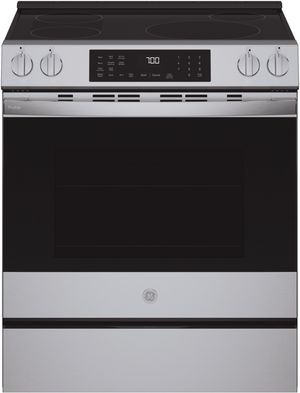
Busy families who want the oven working as hard as the cooktop should start here. This 30-inch slide-in drops into a standard range opening, so a kitchen already wired for an electric range is usually a direct swap rather than the rewiring project covered earlier. No preheat air fry runs inside the oven cavity and retires the countertop fryer. The EasyWash oven tray lifts out for sink cleaning, and the fingerprint resistant stainless finish handles the handprints a family kitchen collects daily. Smart connectivity adds remote monitoring and alerts, which suits induction’s very fast response.
Top Features
- No preheat air fry: Air fries directly in the oven with no preheat wait and no separate countertop appliance taking up space.
- EasyWash oven tray: A removable tray that goes to the sink instead of turning into a scrubbing session inside the oven.
- Fingerprint resistant stainless: Keeps a high-traffic front panel looking clean between wipe-downs in a busy household.
- Smart connectivity: Remote monitoring and notifications so a fast induction cooktop and a running oven both stay in view.
Bosch 800 Series 36” Stainless Steel Pro Style Induction Range
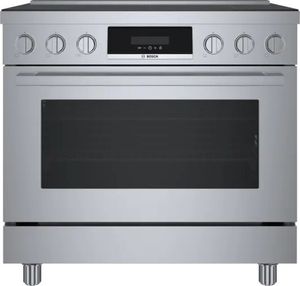
Cooks who have outgrown a 30-inch cooktop and have the wall space for 36 inches belong in front of this Bosch. Those extra six inches solve the crowding problem directly, giving you room to run a stock pot and a wide skillet on properly sized elements at the same time, which is exactly the coverage issue described above. Pro style construction brings heavy hardware and a commercial look without a gas line or its combustion heat. A wider range draws more total power, so let our team review your panel and circuit before delivery.
Top Features
- 36-inch cooking surface: More usable width so large pans sit on correctly sized elements instead of crowding each other.
- Pro style build: Heavy commercial-look hardware and construction without a gas connection or open-flame heat in the kitchen.
- Bosch 800 Series engineering: A premium tier known for quiet operation, which matters directly to the noise myth above.
- Electrical planning included: Our installers verify circuit and breaker requirements against the spec sheet before your delivery date.
Café 30” Stainless Steel Slide-In Induction Range
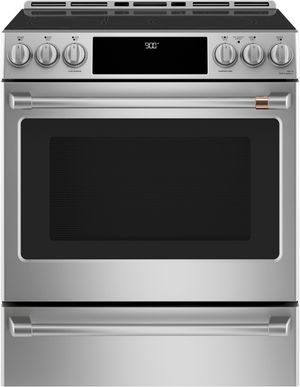
Kitchens where the range has to match the cabinet hardware are exactly where Café belongs. This 30-inch slide-in delivers induction cooking inside a design line built around customizable handles and knobs, so the same range reads brushed stainless in one kitchen and warm bronze in another. It fits the same standard 30-inch opening as the GE Profile above, which keeps cutout and counter work simple during a remodel. For a shopper who has already settled the cookware and wiring questions, this is where the decision turns to finish, proportion, and design continuity.
Top Features
- Customizable hardware: Handle and knob options let the range match cabinet pulls and faucet finishes instead of fighting them.
- Standard 30-inch slide-in fit: Replaces an existing 30-inch range without new cabinet or countertop work.
- Design-forward stainless: Built for open-concept kitchens where the range is visible from the living space.
- Flush slide-in installation: The front controls and overlapping edges give a built-in look against the countertop.
Fisher & Paykel Series 11 48” Stainless Steel Pro Style Induction Range
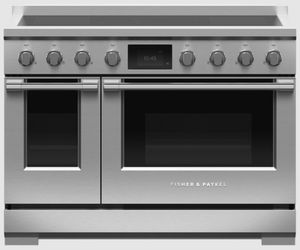
Serious cooks planning a full kitchen build should look hard at the 48-inch Series 11. This is the widest range in this lineup, with a cooktop surface broad enough to run several large pans at once and substantial oven capacity beneath it, which is the configuration that handles holiday and entertaining volume. A range this size carries the largest electrical demand of the group, so panel capacity and circuit sizing get evaluated early rather than on delivery day. Pro style construction plus induction control means no combustion heat pouring into an already warm Texas kitchen.
Top Features
- 48-inch pro style width: The largest cooking surface here, sized for entertaining and multi-pan holiday cooking.
- Series 11 construction: Premium build and finish intended as the focal point of a custom kitchen.
- Substantial oven capacity: Room underneath for large roasting pans and sheet trays alongside the wide cooktop.
- Electrical assessment first: The biggest range needs the earliest panel review, which our team handles before you order.
Frigidaire Gallery 30” Smudge-Proof Stainless Steel Slide-In Induction Range with Stone Baked Pizza
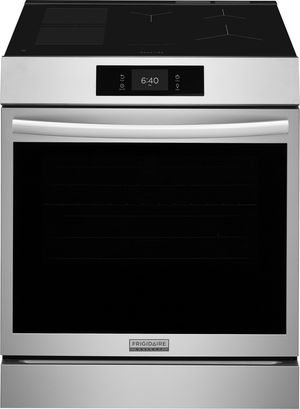
Households that make pizza more than once in a while get a real reason to choose this one. The Stone Baked Pizza function is the differentiator, built to drive the bottom heat that produces crisp crust rather than the pale, soft base a standard bake cycle tends to leave. It is a 30-inch slide-in like the GE Profile and Café above, so the cutout math stays identical, and the smudge-proof stainless keeps fingerprints off a front panel the whole family touches. A specialty cooking mode without premium pricing makes this the practical family pick.
Top Features
- Stone Baked Pizza mode: A dedicated setting aimed at crisp bottom crust instead of a soft, underbaked base.
- Smudge-proof stainless finish: Resists fingerprints on the surface kids and adults grab most often.
- Standard 30-inch slide-in: Fits an existing 30-inch opening, keeping the swap simple in an older DFW kitchen.
- Family-friendly value: A specialty oven feature at a mainstream price point rather than a premium tier.
Frigidaire Professional 30” Smudge-Proof Stainless Steel Slide-In Induction Range
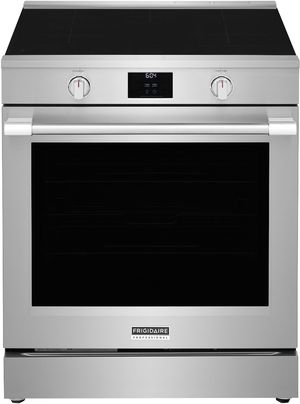
Shoppers who want a step up in build and cooking features but cannot give up a 30-inch opening should compare this Professional model directly against the Gallery above. Same width, same slide-in installation, higher tier of hardware, finish, and capability, which is the cleanest way to buy more range without touching a single cabinet. The smudge-proof stainless holds up in a kitchen where the range is the first thing anyone reaches for. If your cabinet run is fixed at 30 inches and the budget allows moving upmarket, see this one in person.
Top Features
- Professional tier at 30 inches: Upgraded build and features in the same footprint as a mainstream slide-in range.
- No cabinet modification needed: Steps up the kitchen without changing the opening, countertop, or backsplash.
- Smudge-proof stainless: Keeps the most-touched panel in the kitchen looking presentable with minimal effort.
- Direct upgrade comparison: The natural side-by-side against the Gallery model for buyers deciding how far to step up.
Ready to Cook on Induction Stoves? See One in Action Today
Most of the cookware in your cabinet already qualifies, the electrical work is a real project only if you are coming from gas, and induction beats a high-BTU burner on both boil speed and low-end control. The glass is engineered for the job, the pacemaker concern has no documented case behind it, and the noise is the pan talking rather than a defect. Seven myths, and not one of them survives contact with the actual mechanism.
Come see for yourself at Texas Appliance. Shop induction stoves online or visit a showroom, watch water come to a boil on a live element, put your hand on the surface next to the pan, and get a personalized recommendation from someone who knows what a 1970s Arlington panel looks like. Our team handles the electrical coordination and professional installation that a big-box drop-off leaves in your driveway, and our in-house service technicians are still local three years later when you need them. That is what buying from an independent Dallas–Fort Worth retailer gets you.
Frequently Asked Questions about Induction Stoves
You need cookware with a ferromagnetic base, and the test is to press a refrigerator magnet against the bottom of each pan, which works if the magnet grips firmly. Cast iron, enameled cast iron, carbon steel, and magnetic stainless steel all qualify, so most kitchens already own several pieces and only need to replace one or two.
Most full-size induction cooktops and ranges need a dedicated 240-volt circuit rated somewhere between 30 and 50 amps, but a full electrical upgrade is rarely required. A home already running an electric range usually has the correct circuit in place, while a gas-to-induction conversion needs a new circuit run and a panel capacity check.
Induction stoves generate a low-frequency non-ionizing electromagnetic field that falls off sharply within an inch or two of the surface, and there are no documented cases of induction-related pacemaker injury. Centering the pan and keeping a modest distance from the cooktop face are sensible precautions, and anyone with an older or unipolar implant should confirm with the device manufacturer or a cardiologist.
Yes, induction is meaningfully faster, with published tests showing a large pot of water reaching a rolling boil in a few minutes on a high-power element versus well over ten minutes on a high-BTU gas burner. The gap comes from energy transfer, since induction puts roughly 85 to 90 percent of its energy into the pan while gas delivers closer to 35 to 65 percent.
A low hum at high power comes from vibration in multi-layer pan bases, and a steady whir is the internal cooling fan, so neither one indicates a fault. Crackling usually means a warped or poorly bonded pan, while a high-pitched whine with no pan on the element is worth a service call.
Induction pricing now overlaps heavily with comparable gas models at the same feature tier, with mainstream 30-inch ranges commonly falling in the $1,200 to $2,500 range. Operating cost typically favors induction because of its higher energy transfer efficiency and the reduced cooling load from keeping waste heat out of the kitchen.
Why Trust Texas Appliance?
With roots back to the 1950s, Texas Appliance is an established, locally owned and operated, residential major appliance retailer serving both residential and builders’ needs. Our 4 locations allow us to offer a full spectrum of appliances to meet your every need. With over 40 major quality brands, Texas Appliance has one of the largest displays of built–in and free–standing appliances in the state of Texas.
We will be the best appliance dealer in our markets by exceeding our customers' expectations in every way. We will treat our customers, vendors and fellow employees with respect, honesty, integrity and appreciation. The difference between a "Good" company and a "Great" company lies in its' employees' determination.
Shop Induction Stoves at Texas Appliance
Stop by Texas Appliance’s Fort Worth Store and Outlet locations to see what a difference buying local with an experienced staff can make. Or shop Mattresses online! Our friendly experts are always happy to help you find the best Sealy mattresses for your bedroom — whether you call us at 817-299-2800, use our online chat feature, or visit us in person.