

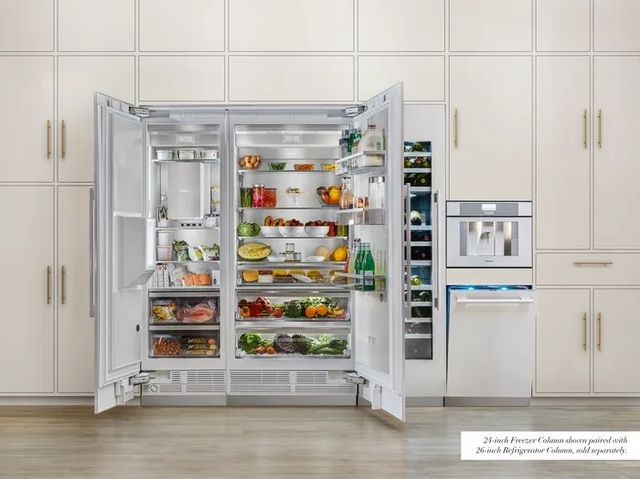
The cabinet opening is already framed at 42 inches, the countertop template is scheduled, and the refrigerator decision is the one thing still holding up the whole kitchen. Four premium units sit side by side, each one carrying a price close to a used car, and the spec tags read like engineering documents. Dual compressors. Air purification. Panel-ready fronts. Somewhere in that pile of terminology is the difference between a high end fridge that keeps romaine crisp for two weeks and one that just looks expensive.
See Premium Refrigeration Side by Side
Compare built-in, integrated and column refrigerators from the top luxury brands in one showroom, with specialists who handle measurement, panels and installation. Shop the full lineup online or visit us in person.
Here is the good news for anyone stuck at that point in a remodel: the differences are learnable, and most of them come down to five or six decisions. At Texas Appliance, our team walks homeowners through these choices every day, from column layouts to panel fabrication timing. This guide breaks down what actually separates premium refrigeration from mainstream models, how the leading luxury brands differ in character and strength, a side-by-side brand comparison, the honest trade-offs nobody puts on a spec sheet, and how to match the right brand to the kitchen you already have.
Key Takeaways
- Cooling architecture is the real dividing line: Premium models use dual compressors and separate evaporators so the fresh food and freezer sections never share air, which protects humidity and stops odor transfer.
- Format matters more than brand at first: Built-in, fully integrated, column and counter-depth units install differently and hold different amounts of food, so the cabinet opening should narrow the field before any logo does.
- Expect less capacity for more money: A 36-inch built-in typically holds several cubic feet less than a standard-depth model of the same width because the cabinet is shallower and the compressor sits inside the box.
- Service access changes the math: Premium sealed systems carry longer warranties, but parts and authorized service availability in your area affect ownership cost more than the sticker price does.
What Makes a Fridge High-End: Features That Justify the Price
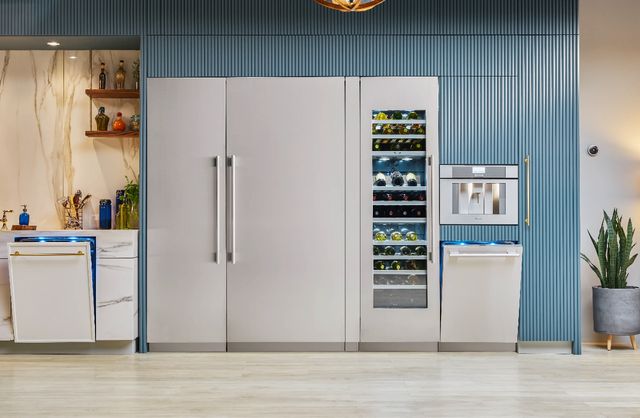
Price alone does not define this category. The engineering does. A mainstream refrigerator runs one compressor and one evaporator, then splits that cold air between the freezer and the fresh food section through a damper.
A premium unit separates the two systems entirely. Two compressors, two evaporators, two sealed air paths. Moist air stays in the produce compartment where it belongs, and dry freezer air never carries the smell of last week’s salmon into the butter.
That separation is the single biggest reason produce lasts longer in a high end fridge. Everything else builds on it.
The Technology You Are Actually Paying For
- Variable-speed compressors that hold temperature within roughly one degree instead of swinging three or four degrees between cycles
- Air purification systems that scrub ethylene gas, the ripening agent that makes one aging apple spoil an entire drawer
- Vacuum-sealed or humidity-controlled drawers that let you set produce and protein zones independently
- Magnetic door gaskets and heated door frames that keep flush-inset doors sealing tightly year after year
- Rapid recovery after door openings, which matters far more in a busy household than peak cooling capacity
What You Can Inspect on a Showroom Floor
Specs are easy to print. Build quality is easy to feel. Pull a drawer all the way out and watch whether it rides on full-extension metal glides or plastic rails.
Look for a stainless interior rather than molded plastic, cantilevered glass shelves that carry weight without a front rail, and hinges that feel machined instead of stamped. Open the door to 90 degrees and let go. A premium hinge holds position; a budget hinge drifts.
One more check our appliance experts always recommend: ask which parts of the warranty cover the sealed system specifically. Most premium brands back the sealed system for 10 to 12 years, and that coverage is worth more than any feature on the tag.
Built-In, Integrated, Column and Counter-Depth Refrigerators Explained
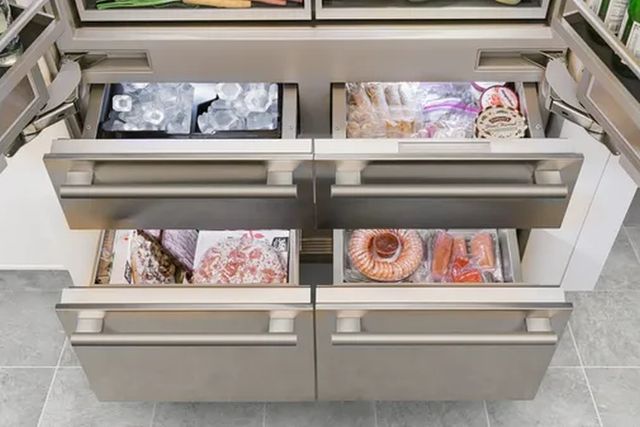
Four formats get confused constantly, and choosing the wrong one costs either cabinet money or capacity.
Freestanding pro-style units sit proud of the cabinets with a commercial look and full depth. Counter-depth models are shallower so the doors line up roughly with your countertop, but they still stand alone and finish on all sides. Built-in refrigerators are engineered to sit flush inside a cabinet run, usually 24 inches deep, with a trim kit or stainless front. Fully integrated units go one step further and accept custom door panels that match your cabinetry, so the appliance disappears into the room.
Column refrigeration is its own approach. Instead of one box, you install a separate refrigerator column and a separate freezer column, often with a wine or convertible column between them. Common widths run 18, 24, 30 and 36 inches, and designers pair them because a household that never freezes much can buy 36 inches of fresh food and only 18 inches of freezer.
Read more:
Why Are Built In Refrigerators So Expensive?
Counter Depth Refrigerator Dimensions Explained
The Capacity Trade-Off Nobody Mentions
Built-in and integrated units hold less than you expect. A 36-inch built-in commonly lands near 19 to 21 cubic feet, while a 36-inch standard-depth model can approach 27. The shallower cabinet and the internal compressor both take space.
Shop by cubic feet, not by exterior width. That single habit prevents the most common regret in this category.
Before you fall for any model, run the measurements in this order:
- Measure the cabinet opening width, height and depth, then subtract the clearances the manufacturer requires on each side and at the top
- Confirm whether the compressor is top-mounted or bottom-mounted, since that changes required grille clearance and toe-kick height
- Check the door swing against adjacent walls, islands and handles, especially in a galley layout
- Verify the electrical outlet position and whether a dedicated circuit and water line already exist behind the cabinet
- Walk the delivery path from the truck to the kitchen, measuring every doorway, stair turn and hallway pinch point
That last step is the one people skip. A 48-inch built-in weighs several hundred pounds and does not negotiate a tight stairwell landing.
The Leading High-End Refrigerator Brands and What Each Does Best
Every luxury refrigerator brand has a personality. Matching that personality to how you cook and entertain matters more than chasing a single best name.
Preservation-First Brands
Sub-Zero built its reputation on dual refrigeration, air purification borrowed from NASA-derived technology, and a preservation obsession that shows up in vacuum-sealed drawers and tight temperature holds. It fits the buyer who shops fresh several times a week and expects produce to last. It is not for the shopper hunting the lowest entry price into the premium tier.
Liebherr specializes in refrigeration and nothing else, with excellent interior organization and efficient cooling in narrower footprints. That focus appeals to buyers who want European engineering without a full suite commitment. It is not for someone who wants a matching pro range from the same badge.
Miele brings precision, quiet operation and true integration into fine cabinetry, and it pairs naturally with a full Miele kitchen. It is not the pick for a buyer who wants a bold stainless statement piece.
Design-Forward Brands
Thermador leads on column flexibility, letting you compose refrigeration around your layout rather than the other way around, and it backs that with generous interior lighting and organization. Buyers running a remodel with a designer gravitate here. It is not the simplest choice for a straight one-for-one replacement.
Monogram delivers statement hardware, heavy handles and a confident industrial look, and it shares engineering resources with GE Profile, which broadens service access. It fits the buyer who wants the kitchen to announce itself. It is not for someone chasing a fully hidden appliance front.
JennAir goes further into bold styling with obsidian interiors and dramatic lighting, appealing to buyers who treat the kitchen as design space. It is not the value pick.
Viking carries pro-style presence with commercial-inspired proportions, ideal for a heavy cook building a professional look. It is not the quietest option in a great room.
Accessible Entry Points
Fisher and Paykel earns its place through modular refrigeration, including refrigerator drawers that let you place cold storage exactly where you prep. Bosch and Café both offer counter-depth and panel-ready options that step into premium territory at a friendlier price, with Café adding customizable hardware finishes. SKS, the Signature Kitchen Suite line, is worth knowing for built-in column and French door units with convertible zones aimed at serious food storage.
Suite continuity is worth weighing here. Thermador, Bosch and Gaggenau share a parent company, as do Monogram, Café and GE Profile, and JennAir sits alongside KitchenAid. If matching your range, dishwasher and ventilation matters, those relationships shape what is realistic.
High-End Fridge Brand Comparison: Features, Formats and Price Ranges
| Brand | Signature Strength | Formats Available | Standout Freshness Tech | Price Tier | Best-Fit Buyer |
|---|---|---|---|---|---|
| Sub-Zero | Preservation engineering | Built-in, integrated, column | Air purification and vacuum-sealed drawers | Highest | The fresh-food shopper |
| Thermador | Column flexibility | Built-in, integrated, column, counter-depth | Sensor-controlled fresh food zones | High | The remodel buyer |
| Monogram | Statement hardware | Built-in, integrated, column | Precision temperature and filtered ice | High | The design-first cook |
| JennAir | Dramatic interiors | Built-in, integrated, column | Obsidian interior with LED zones | High | The style-led buyer |
| Miele | Quiet precision | Integrated, column | DynaCool and active air cleaning | High | The integration purist |
| Fisher and Paykel | Modular refrigeration | Integrated, column, drawers | ActiveSmart adaptive cooling | Mid to high | The flexible-layout planner |
| Liebherr | Refrigeration specialist | Built-in, integrated, column | BioFresh humidity zones | Mid to high | The organization lover |
| Viking | Pro-style presence | Built-in, counter-depth | ProChill temperature management | High | The serious home cook |
| SKS | Convertible storage | Built-in, column, French door | Convertible zones and craft ice | High | The bulk food storer |
| Bosch and Café | Accessible premium | Counter-depth, built-in | FarmFresh and precision cooling | Entry premium | The value-minded upgrader |
Every brand in this table offers panel-ready options on at least part of its built-in lineup, and all of them run dual compressor cooling except the entry-premium models from Bosch and Café.
Read this table left to right by your own priority rather than top to bottom by price. Start with the format your cabinet allows, then choose the brand whose signature strength matches how your household actually eats.
Preservation Technology: How Premium Refrigerators Keep Food Fresh Longer
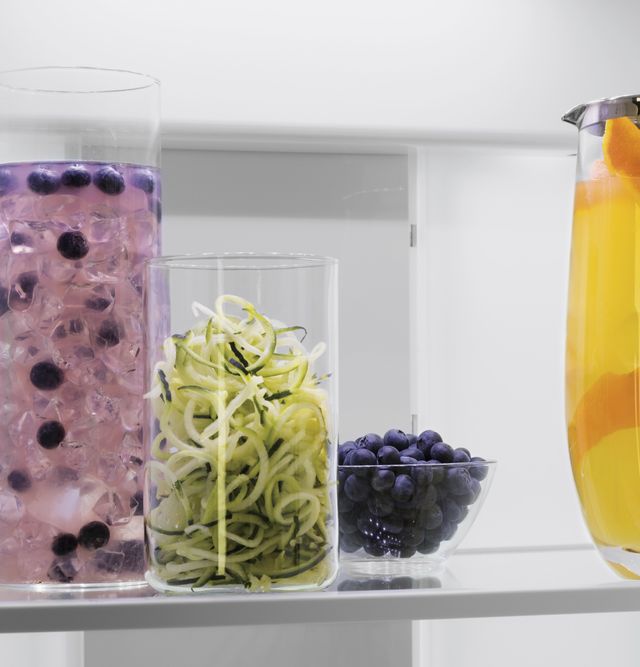
Independent zones do the heavy lifting. When the produce drawer holds high humidity and the meat drawer runs a few degrees colder with lower humidity, both foods last measurably longer than they would in a shared compartment.
Ethylene management works alongside that. Ripening fruit releases ethylene gas, and an air scrubber or carbon filter pulls it out of circulation before it accelerates everything nearby. Antimicrobial surfaces and UV-assisted air systems reduce the bacteria that speed spoilage.
Convertible zones add real flexibility. A drawer or column that switches between refrigerator, freezer and soft-freeze settings lets a household run more freezer space during holiday cooking and more fresh space in summer.
Water, Ice and Smart Features Worth Paying For
Filtration standards matter more than filter marketing. Look for certification against specific contaminants rather than a general claim, and decide early between an internal dispenser that preserves a clean door front and an external dispenser that is easier to use with a pitcher.
Craft ice, nugget ice and clear gourmet cubes have moved from novelty to a common request, especially for households that entertain. A dedicated ice maker column produces far more than a standard fridge ever will.
On connectivity, keep the useful and skip the rest:
- Remote temperature monitoring and door-ajar alerts, which catch a real problem before groceries are lost
- Filter replacement reminders tied to actual water usage rather than a calendar
- Diagnostics that let a service technician arrive already knowing the fault code
- Interior cameras, which are genuinely handy for some shoppers and forgotten within a month by others
Each of these ties back to one measurable outcome: fewer groceries in the trash. During a Texas summer, when brownouts and heat spikes push cooling systems hard, rapid recovery and steady temperature holds are what keep a full refrigerator safe.
What a High-End Fridge Really Costs to Own
The appliance is one line on the invoice. Plan for the rest.
Custom panels and hardware are fabricated by your cabinet maker and often add meaningfully to the total. Trim kits, cabinet modification for a flush-inset fit, professional installation, a new water line, and haul-away of the old unit all belong in the budget from day one.
The value case shows up over time. Mainstream refrigerators commonly last 10 to 13 years, while premium built-in units are engineered for closer to 20 with proper service. Divide the total installed cost by realistic years of service and the gap narrows considerably.
Two other factors deserve attention:
- Energy use in the built-in category runs higher than a comparable standard-depth model, so compare annual operating estimates rather than assuming premium means efficient
- Parts availability and authorized service coverage in your area determine how quickly a sealed-system repair actually happens, which is why buying from a local dealer with a service department carries real weight
Extended coverage typically adds labor protection beyond the factory sealed-system term. Whether that is worth it depends on how long you plan to stay in the home.
A premium refrigerator earns its keep through preservation performance and a built-in look that no freestanding unit can match. It also asks for more money, more planning and, in most cases, more patience. Weigh both sides honestly before committing to a format.
Pros
Food genuinely lasts longer
Dual cooling systems, humidity zones and ethylene scrubbing extend the useful life of produce, dairy and proteins week after week.
The kitchen looks finished
Flush-inset and panel-ready fronts let the refrigerator sit level with cabinetry instead of interrupting the run.
Build quality holds up
Metal drawer glides, stainless interiors and heavy hinges survive decades of daily use, and premium sealed systems carry long warranties.
Configuration is yours to set
Columns, convertible zones and modular drawers let you buy the exact ratio of fresh to frozen storage your household needs.
Service networks run deeper
Premium brands support authorized technicians and long parts availability, which matters over a 20-year ownership window.
Cons
Installed cost climbs fast
Panels, trim, cabinet modification and professional installation can add thousands beyond the appliance price.
You give up interior space
A built-in or integrated unit holds several cubic feet less than a standard-depth model of the same width, and custom orders often carry longer lead times.
How to Choose the Right High-End Refrigerator Brand for Your Home
The right answer depends less on the brand rankings and more on which buyer you are.
The remodel buyer working from cabinet drawings has the most freedom and should start with column planning, because that decision drives the entire elevation. The replacement buyer working around a fixed opening should start with the opening dimensions and shop only what fits without cabinet work.
Entertainers should prioritize ice production and beverage zones, since a dedicated ice maker or wine column solves the problem a bigger fridge never will. Large families buying in bulk should chase usable cubic feet and convertible freezer space above all else. The design-first buyer should confirm panel-ready availability and hardware options before falling for an interior.
Questions to Bring to Your Showroom Appointment
- What is the current lead time on this configuration, and does it change with a custom panel?
- When does your cabinet maker need panel specifications, and who supplies the template?
- What clearances does this model require, and does your existing opening meet them?
- Is your address inside the service coverage area, and who performs warranty work?
- Does the freezer configuration match how your household actually shops and cooks?
Common regrets cluster around three mistakes: choosing exterior width over usable capacity, skipping the delivery path measurement, and mismatching finishes across a suite bought in stages.
How Texas Kitchens Change the High End Fridge Equation
North Texas puts demands on refrigeration that a national buying guide never accounts for. Summer heat pushes garage and utility-room installations well past the ambient temperature range many units are rated for, and hard water across much of the metroplex shortens filter life and leaves scale in ice makers far faster than the manufacturer’s replacement schedule assumes. Open-concept layouts common in newer builds also mean the refrigerator runs in the same room where people gather, so compressor noise that seems trivial in a showroom becomes noticeable at dinner.
Here is how our team accounts for local conditions when helping homeowners choose:
- Check the ambient operating range before placing any refrigerator or freezer column in a garage, an outdoor kitchen or an uninsulated utility room
- Plan on replacing water filters more often than the manual suggests, and consider a whole-home softener if scale is already visible on fixtures
- Favor variable-speed compressors and sound-dampened cabinets when the kitchen opens directly into a living area
- Confirm the unit holds temperature through short power interruptions, which matter during storm season and summer grid strain
- Ask about surge protection for connected models, since control boards are the most common storm-related failure
Read more:
Why Designers Love Fisher & Paykel Refrigerators
How Thermador Appliances Compare to Other Luxury Brands
Top High-End Refrigerators Available at Texas Appliance
Our showroom carries premium refrigeration you can open, measure and compare in person, with specialists who handle panel coordination and installation from order to delivery. The models below represent the range of formats worth considering, from slim columns to full-size built-ins. Every one of them is available through Texas Appliance with professional installation and local service after the sale.
Thermador Freedom 30” Panel-Ready Column Refrigerator

Column refrigeration gives you the freedom to buy fresh food space and freezer space in whatever ratio your household needs, and this 30-inch panel-ready unit is where most of those layouts begin. Its 16.8 cubic feet are dedicated entirely to refrigeration, so nothing is lost to a freezer compartment you rarely use. The panel-ready front accepts custom cabinetry so the appliance reads as furniture rather than equipment. It suits remodel buyers designing a refrigeration wall around how they actually cook and shop.
Top Features
- Panel-ready front: Accepts custom door panels that match your cabinetry for a fully built-in look.
- All-refrigeration design: The full 16.8 cubic feet serve fresh food, with no shared freezer space.
- Built-in column format: Installs flush within a cabinet run for a finished, integrated elevation.
- Pairs with matching columns: Combine with freezer or wine columns to compose the exact layout you need.
Thermador Freedom 36” Panel-Ready Column Refrigerator

Step up to 36 inches and the column format starts to feel generous. With 20.6 cubic feet of pure refrigeration, this Thermador handles the way large families actually shop, with room for platters, produce and a full week of groceries without stacking. The panel-ready front disappears into surrounding cabinetry, which is exactly what design-led kitchens ask for. Households that entertain often, or anyone who buys fresh several times a week, get the most out of this width paired with a companion freezer column.
Top Features
- Generous fresh capacity: 20.6 cubic feet devoted entirely to refrigerated storage.
- Custom panel compatibility: Built to accept cabinetry panels for a flush, integrated front.
- Full-size column width: The 36-inch footprint anchors a refrigeration wall in larger kitchens.
- Flexible pairing: Designed to sit alongside matching freezer and wine columns.
Thermador Freedom 48” Built-In French Door Refrigerator
Shop French Door Refrigerators
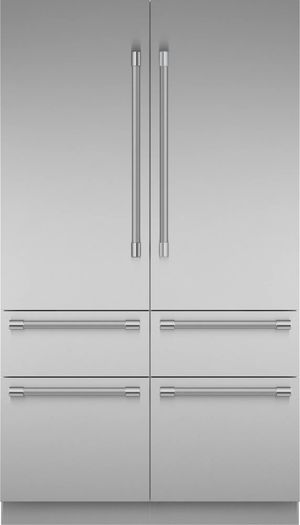
For buyers who want built-in refrigeration without committing to a column layout, this Thermador French door model delivers the flush cabinet fit with a single, familiar door configuration. The stainless finish carries a professional presence that pairs naturally with a pro range and matching ventilation. French doors also mean shallower door swings, which helps in kitchens where an island sits close to the refrigerator wall. It fits homeowners upgrading a full kitchen who want premium refrigeration in one straightforward unit.
Top Features
- Built-in installation: Sits flush within cabinetry for a finished, custom appearance.
- French door configuration: Narrower door swings work better in tight kitchen aisles.
- Stainless steel finish: Coordinates with pro-style ranges and ventilation for a matched suite.
- Freedom collection engineering: Built to Thermador’s built-in standards for temperature stability.
GE Profile 48” Built-In Side-by-Side Refrigerator
Shop Side-by-Side Refrigerators
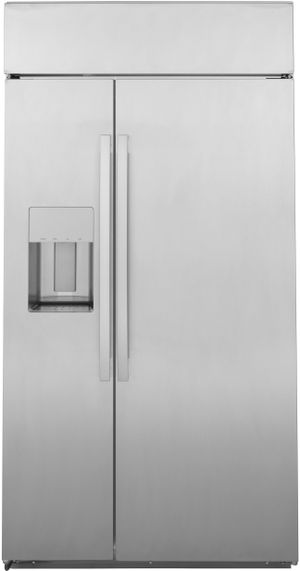
Capacity is where this one wins. At 48 inches wide and 28.7 cubic feet, it offers the kind of storage that built-in refrigeration usually asks you to sacrifice, which makes it a strong answer for large households that cook at volume. The side-by-side layout puts frozen and fresh food at eye level together, so nothing gets buried. Counter-depth construction keeps it flush with cabinetry, and the stainless finish works in both traditional and transitional kitchens without custom panels.
Top Features
- Large built-in capacity: 28.7 cubic feet across a full 48-inch width.
- Side-by-side layout: Fresh and frozen storage share eye-level access on both sides.
- Counter-depth build: Installs flush with cabinetry for a built-in appearance.
- Stainless steel finish: Ready to install without waiting on custom panel fabrication.
SKS 36” Panel-Ready Built-In French Door Refrigerator
Shop French Door Refrigerators
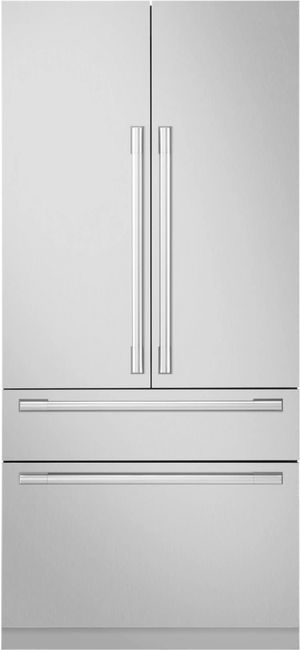
Signature Kitchen Suite built this 36-inch French door model for people who take food storage seriously. Its 19.3 cubic feet sit behind a panel-ready front, so the unit blends into cabinetry while the counter-depth build keeps the doors in line with your countertops. The French door layout puts fresh food at the top where you reach most often, with freezer storage below. It suits design-focused remodels that still need real capacity and a fully integrated look.
Top Features
- Panel-ready exterior: Takes custom cabinet panels for a fully integrated kitchen front.
- Counter-depth French door design: Aligns with cabinetry while keeping fresh food at eye level.
- 19.3 cubic feet of storage: Balanced fresh and frozen space in a 36-inch footprint.
- Built-in installation: Engineered to sit flush within a cabinet opening.
Bring Home a High End Fridge That Earns Its Place in Your Kitchen
Premium refrigeration separates itself through dual cooling systems, humidity control and build quality that holds up for decades, while the leading brands differ mainly in whether they lead with preservation, design or flexibility. Format and usable capacity should drive the final call, not exterior width or brand loyalty. Once those are settled, the right high end fridge becomes an obvious choice rather than a gamble.
Come see them with the doors open. At Texas Appliance, you can compare built-in refrigerators, integrated columns and counter-depth models side by side in one showroom, with specialists who know the clearance requirements, panel timing and installation details that big-box stores rarely stock or staff for. Our team handles professional delivery and installation, coordinates custom panels with your cabinet maker, and backs the sale with local service. Visit a Texas Appliance showroom or contact our team for a personalized recommendation built around your kitchen.
Read more:
Best GE Monogram Appliances for Luxury Kitchen Remodels
6 Most Reliable Refrigerator Brands for Modern Kitchens
Frequently Asked Questions about High End Fridges
Sub-Zero is widely regarded as the benchmark for preservation performance, while Thermador leads on column flexibility and Monogram on design presence. The best brand depends on whether you prioritize food longevity, layout freedom or a specific look in your kitchen.
Premium built-in and integrated refrigerators typically start in the mid four figures and climb into five figures for large column configurations. Custom panels, trim kits and professional installation add to that total, so budget for the installed cost rather than the appliance alone.
A built-in refrigerator sits flush in a cabinet run with a finished front, usually stainless steel, while an integrated model accepts custom cabinet panels so it disappears into the room. Both install flush, but only integrated units are designed to be hidden entirely.
Column refrigerators are worth it for households whose fresh-to-frozen needs do not match a standard 60-40 split. Buying refrigeration and freezing separately lets you size each to real habits instead of accepting a factory ratio.
Premium built-in refrigerators are engineered for roughly 20 years of service, while mainstream models commonly last 10 to 13. Longer sealed-system warranties and better parts availability are the main reasons for that gap.
Yes, and the mechanism is measurable rather than marketing. Separate cooling systems maintain higher humidity in produce drawers and steadier temperatures overall, which slows spoilage and reduces the groceries you throw away.
Why Trust Texas Appliance?
With roots back to the 1950s, Texas Appliance is an established, locally owned and operated, residential major appliance retailer serving both residential and builders’ needs. Our 4 locations allow us to offer a full spectrum of appliances to meet your every need. With over 40 major quality brands, Texas Appliance has one of the largest displays of built–in and free–standing appliances in the state of Texas.
We will be the best appliance dealer in our markets by exceeding our customers' expectations in every way. We will treat our customers, vendors and fellow employees with respect, honesty, integrity and appreciation. The difference between a "Good" company and a "Great" company lies in its' employees' determination.
Shop Dishwashers at Texas Appliance
Stop by Texas Appliance’s Fort Worth Store and Outlet locations to see what a difference buying local with an experienced staff can make. Or shop Mattresses online! Our friendly experts are always happy to help you find the best Sealy mattresses for your bedroom — whether you call us at 817-299-2800, use our online chat feature, or visit us in person.