

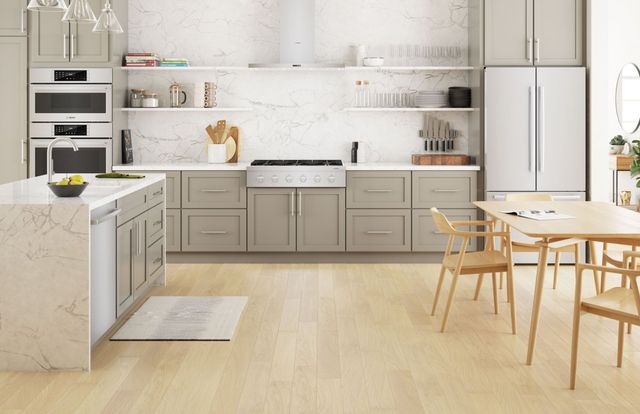
Brisket day starts at five in the morning and the trouble shows up by six. A cast iron skillet holding a cold ribeye drops the burner flame the moment the meat hits the pan, so the sear turns gray instead of brown. Two burners over, a stockpot sits at a lazy shimmer while three other pans wait their turn. The butter sauce on the back left is the worst of it, because the low setting either scorches it or barely warms it, and there is nothing between those two. That gap between what a burner promises and what it delivers is exactly what a rangetop cooktop is built to close.
Take a breath, because the fix is more straightforward than the spec sheets make it look. At Texas Appliance, our team helps home cooks configure professional cooking surfaces every week, from burner mix to hood sizing to the cabinet work that has to happen first. This guide covers how a rangetop cooktop differs from a standard cooktop and a range, the burner and module features that change real cooking, a side-by-side size and brand comparison, the honest trade-offs, and five feature-packed models worth a showroom visit.
See Pro Burners Fire Up in Person
Compare 36-inch and 48-inch pro-style rangetops, griddle modules and burner layouts in one showroom, with specialists who size ventilation and confirm cabinet requirements before you order. Shop online or come cook the numbers with our team.
Key Takeaways
A rangetop is a cooking surface without an oven: It drops into a full-depth cabinet with front-mounted knobs and a raised back panel, and it pairs with one or two wall ovens instead of carrying an oven underneath.
- Simmer separates the pros from the pretenders: Peak BTU output gets the attention, but the ability to hold a true low flame under a butter sauce is what most home cooks notice every single week.
- Ventilation is not optional: Combined burner output on a pro surface demands real hood capacity and correctly sized duct, and island installations need more than wall installations.
- Budget the project, not the appliance: Wall ovens, hood, duct, gas work and cabinet modification belong in the number before you compare a rangetop cooktop against a pro range.
Rangetop Cooktop vs Standard Cooktop vs Range: What Actually Differs
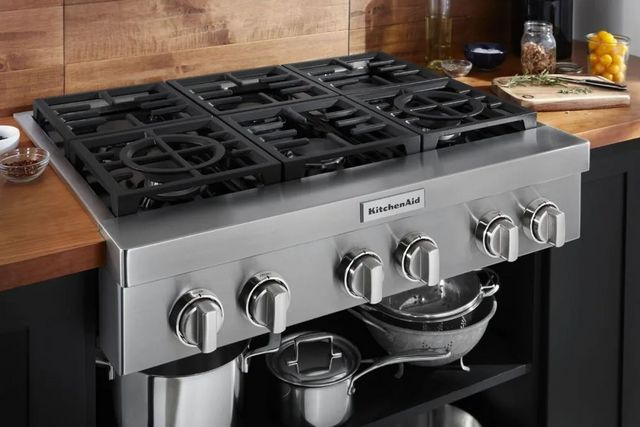
Three cooking surfaces get shopped against each other, and they install in completely different ways.
A rangetop cooktop is a professional drop-in surface with no oven beneath it. Knobs sit on the front face, a raised back and side panels contain splatter, and the unit needs a full-depth cabinet rather than a shallow counter cutout. A standard cooktop sits flush in the countertop, runs shallow, and often uses top-mounted or touch controls. A slide-in or freestanding range combines the surface and the oven in a single appliance.
That difference drives the whole kitchen plan. A rangetop requires the cabinet beneath it to be modified or removed, gas and electrical brought to the right position, and the countertop cut to a deeper spec.
Why Most Rangetop Buyers Add Wall Ovens
Take the oven out from under the burners and it has to go somewhere. Most buyers put one or two wall ovens at eye level in a nearby cabinet run, which changes daily cooking more than people expect.
- No more bending to check a roast or pull a heavy turkey out at floor level
- Two ovens can run different temperatures during holiday cooking
- The cooking zone and the baking zone separate, so two people work without colliding
- Oven controls sit at eye level instead of behind a hot cooking surface
Here is a plain decision rule. If you cook on multiple burners at once and want real control at both extremes, a rangetop cooktop earns its place. If your cooking is mostly one or two pans and oven space matters more, a pro-style range does the same work for less money and less construction.
Burner Power and Precision: BTUs, Dual-Stacked Burners and True Simmer
High BTU numbers sell rangetops. Low BTU control is what people keep.
A high-output burner matters for a hard sear, wok cooking and bringing a big stockpot to a rolling boil quickly. Peak BTU alone is misleading, though, because a burner that produces enormous heat but cannot step down cleanly leaves you cooking on guesswork.
The low end is where a professional surface separates itself. Melt settings, hold functions and a genuine low simmer let a hollandaise or a long braise sit for an hour without scorching. Dual-stacked burners exist for exactly this reason, using a separate low-flame ring so the burner does not have to choke a large ring down to a flicker.
Sealed Burners, Open Burners and Grate Design
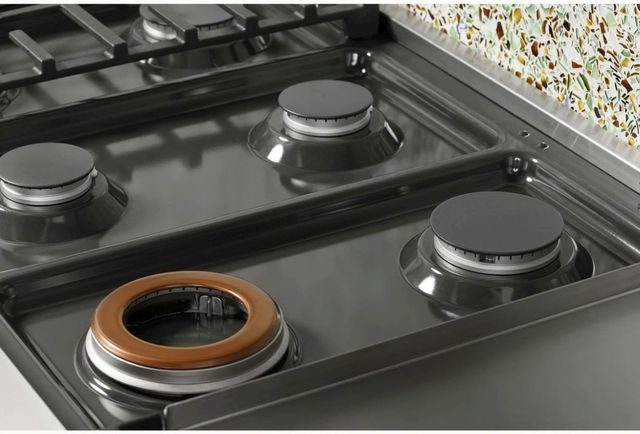
Sealed burners are welded to the burner surface, so spills stay on top and cleanup is straightforward. Open burners sit above a burner box that catches spills, which many serious cooks prefer for flame character and heat spread, and which asks for more cleaning effort in return.
Grates matter more than shoppers expect. Continuous heavy cast iron lets you slide a full Dutch oven from one burner to another without lifting, and it holds heavy cookware flat.
- Six burners suit a cook who runs multiple pans and wants two high-output positions
- Four burners plus a griddle suit breakfast-heavy households and anyone cooking for a crowd
- Four burners plus a French top suit sauce work and long simmering
All-burner layouts suit high-volume cooking where modules would only reduce capacity
One more practical note: natural gas and liquid propane are not interchangeable without a conversion kit, and conversion should be done at installation rather than after the fact.
Griddles, Grills and Modules: Building the Cooking Surface You Want
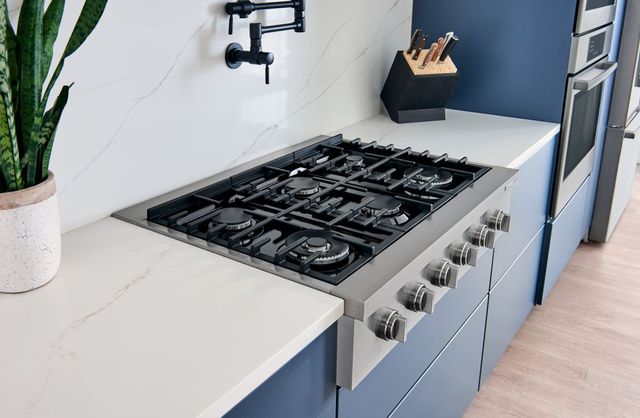
Modules are where a rangetop stops being an appliance and starts being your kitchen.
A thermostatically controlled griddle holds a set temperature, which is what makes pancakes and repeatable smash burgers. A non-controlled plate runs off burner heat and takes more attention. Chrome griddle surfaces clean easily and stay bright, while stainless and steel plates take seasoning and build character over years.
Indoor grills and charbroilers deliver real char, and they also produce the most smoke and grease of anything on the surface. That puts the heaviest demand on your hood and your cleaning routine.
Read more:
7 Top Free Standing Electric Ranges for New Homes & Kitchen Renovations
What You Need to Know Before You Use an Induction Cooktop
The Usage Test Before You Pay for a Module
Every module you add subtracts burner space. A griddle typically replaces two burner positions, and a grill module does the same.
Run this test before ordering: count how many meals in a normal month would genuinely use that module. Fewer than four and the burners are worth more to you than the module is. More than eight and it will earn its place. Anything in between comes down to whether you would rather have the flexibility or the extra pan.
Rangetop Cooktop Comparison: Sizes, Burners, BTUs and Configurations
| Width | Typical Burners | Common Modules | Typical Combined BTU | Suggested Hood CFM | Best-Fit Cooking Style |
|---|---|---|---|---|---|
| 30 inch | 4 burners | Rarely offered | About 50,000 | 600 to 900 | Small kitchens and light pro cooking |
| 36 inch | 4 to 6 burners | Griddle or grill on some models | About 70,000 | 900 to 1,200 | Most home cooks and mixed cooking |
| 48 inch | 4 to 6 burners plus module | Griddle, grill or French top | About 95,000 | 1,200 to 1,500 | Entertainers and multi-pan cooks |
| 60 inch | 6 burners plus two modules | Griddle and grill together | About 120,000 | 1,500 or more | High-volume and enthusiast kitchens |
Every width above needs a full-depth base cabinet matching the unit, and maximum single-burner output runs roughly 18,000 to 22,000 BTU across all four sizes.
Brand character matters as much as size, so compare the badges on what they are built to do well.
| Brand | Signature Strength | Burner Style | Module Availability | Design Language |
|---|---|---|---|---|
| Wolf | Dual-stacked burner control | Sealed dual-stacked | Griddle, French top, charbroiler | Commercial classic |
| Thermador | Star burner heat spread | Sealed star-shaped | Griddle and grill modules | Modern professional |
| BlueStar | Open burner power | Open burner | Griddle and charbroiler | Customizable and industrial |
| Monogram | Balanced pro performance | Sealed | Griddle module | Bold statement hardware |
| Viking | Pro presence and build | Sealed and open options | Griddle, grill, French top | Commercial inspired |
| Bertazzoni | Italian design value | Sealed brass burners | Griddle on select models | Colorful and expressive |
| JennAir | Styling and integration | Sealed | Griddle module | Dark and dramatic |
| Café | Accessible pro styling | Sealed | Integrated griddle | Personalized and modern |
Read the first table to settle width and ventilation, then read the second to match a brand to how you cook. Nothing in either table matters until the hood and cabinet plan support the surface you choose.
Ventilation, Clearances and Installation Planning
Ventilation is the step people underestimate, and it is the one that ruins kitchens when it goes wrong.
Match your hood to the rangetop width at minimum, and go wider when the unit sits on an island. Combined burner output drives the CFM requirement, and a 48-inch surface with a grill module needs serious capacity to keep grease off your cabinets.
Duct size and run length matter as much as the fan rating. A powerful hood pushing through undersized or overly long duct performs like a weak one. Many jurisdictions also require makeup air once a hood passes a certain CFM threshold, which means a dedicated supply that has to be planned before drywall.
The Checklist to Hand Your Contractor
- Cabinet width, full depth confirmation, and whether the base cabinet needs modification or removal
- Countertop cutout dimensions and backsplash height behind the raised back panel
- Side clearance to walls and combustible surfaces, plus vertical clearance to the hood
- Gas line size and shutoff placement, since a high-BTU surface can need a larger supply line
- Dedicated electrical for ignition, lighting and controls
- Hood width, CFM, duct diameter, run length and any makeup air requirement
- Wall oven cabinet location, height and finish match across the suite
Settle these before the order, not after delivery. Our appliance experts run this list with customers during the planning stage because a rangetop that arrives before the cabinet is right sits in a box for weeks.
Rangetop Cooktop Pros and Cons for Home Kitchens
A rangetop cooktop buys you burner power, simmer control and a cooking surface configured around your habits. It asks for more money, more planning and more cleaning in return. Weigh both honestly against a pro-style range before committing.
Pros
Real heat at both extremes
High-output burners sear and boil fast, while dual-stacked low settings hold a true simmer under delicate sauces.
You configure the surface
Griddles, grills and French tops let you build the exact cooking layout your meals call for.
Wall ovens sit at eye level
Separating the oven from the burners removes the bending and makes room for two ovens at different temperatures.
Built to take abuse
Heavy cast iron grates, commercial-grade burners and steel construction hold up to years of hard cooking.
The kitchen looks the part
A pro surface with a matching hood anchors the room visually in a way a standard cooktop never does.
Cons
The project cost climbs quickly
Wall ovens, a properly sized hood, duct work and cabinet modification often exceed the price of the rangetop itself.
Installation is demanding
Full-depth cabinets, gas line sizing and makeup air requirements make this a planned build rather than a swap.
Cleaning takes real effort
Heavy grates, burner caps and a griddle plate all need regular attention, and open-burner designs ask for more.
Cost, Maintenance and Long-Term Ownership
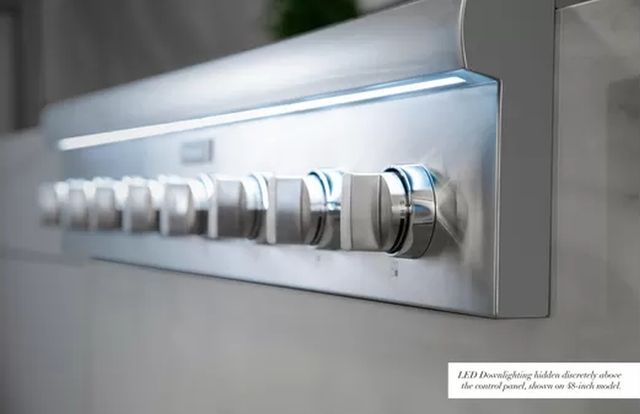
Comparing a rangetop price against a range price is the most common budgeting mistake in this category. The honest comparison puts the rangetop plus wall ovens plus hood and duct against a pro range plus hood.
Maintenance is the other half of ownership. Grates and burner caps come off for cleaning, drip trays or burner boxes need periodic attention, and a steel griddle wants seasoning the same way a cast iron pan does. Sealed burners cut that work down; open burners increase it in exchange for flame character.
Two ownership factors deserve weight:
- Parts availability and authorized service matter more in the professional category, since these units are built to last decades and will eventually need a technician who knows them
- A correctly sized hood protects cabinet finishes and indoor air quality over the life of the kitchen, which is real value that never shows up on a spec sheet
Divide the total project cost across 15 or 20 years of cooking and the number looks different than it does on order day.
Matching a Rangetop to Your Cooking Style
Configuration should follow your cooking, not the showroom display.
The high-heat searer and wok cook needs at least two high-output burners and can skip a griddle entirely. The sauce and braise cook should prioritize dual-stacked low burners or a French top, where gentle even heat is the whole point. The baker cares more about the wall ovens than the surface, so budget should shift accordingly.
Entertainers cooking several dishes at once benefit from 48 inches and a griddle for holding and finishing. The family cook who values simplicity should look hard at a 36-inch sealed-burner surface with continuous grates and skip modules altogether.
Questions to Ask Before You Order
- What is the current lead time on this configuration and finish?
- Does this unit require a conversion kit for your fuel type, and who performs it?
- What hood width and CFM does the manufacturer specify for this model?
- What cabinet modification does the installer expect, and is that quoted?
- Who handles warranty service in your area, and how fast is the typical response?
Common regrets follow a pattern: buying 48 inches when 36 would have cooked the same meals, paying for a grill module used twice a year, and under-sizing the hood to save money during a remodel.
What Texas Cooking Habits Demand From a Rangetop
Cooking in North Texas puts different demands on a burner than a national buying guide accounts for. Brisket and large-format barbecue mean stockpots and heavy Dutch ovens that need burners spaced far enough apart to sit flat without crowding. Tortilla work and comal cooking reward a flat griddle surface far more than a grill module. Summer heat is its own factor, because a high-BTU surface without proper ventilation dumps heat into a house already fighting triple digits, which shows up on the utility bill as much as in comfort. Propane is also common outside city gas service, so fuel conversion is a real planning step rather than a footnote.
Our team weighs these local realities when helping home cooks pick a configuration:
- Confirm burner spacing works for oversized cookware if barbecue prep and large stockpots are part of your routine
- Choose a thermostatically controlled griddle over a grill module if tortillas, fajitas and breakfast volume dominate your cooking
- Size the hood generously when the kitchen opens into a living area, since heat and humidity migrate through open floor plans fast
- Plan propane conversion at installation if your home is outside natural gas service, and confirm the kit is included
- Verify makeup air requirements with your builder early, since high-CFM hoods often trigger them in newer construction
Read more:
How High Should an Over the Range Hood Be Installed?
7 Common Myths About Induction Stoves
Feature-Packed Rangetops Available at Texas Appliance
Five rangetops, five different answers to the same question about how you cook. The lineup below spans accessible pro styling to full commercial-grade construction, in both 36-inch and 48-inch widths, with sealed burners throughout. Every one is available through Texas Appliance with professional installation, ventilation guidance and local service after the sale.
Bosch 800 Series 36” Gas Rangetop
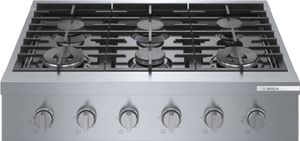
German engineering shows up in the details on this one, and the details are what you cook on every day. The 800 Series brings a 36-inch stainless gas surface into kitchens that want professional performance without commercial-kitchen visual weight. Its clean lines and restrained styling suit transitional kitchens where the hood should be the statement rather than the burners. This is the rangetop for the cook who prizes consistency and finish quality over showmanship, and who plans to pair the surface with matching Bosch wall ovens.
Top Features
- 36-inch gas surface: The most flexible width in the category, sized for most kitchen layouts and hood options.
- Stainless steel construction: Durable, easy to wipe down, and neutral enough to work with any cabinet color.
- Front-mounted controls: Knobs sit on the face where they belong, away from hot pans and reachable mid-cook.
- Suite compatibility: Coordinates with Bosch wall ovens and ventilation for a matched kitchen.
KitchenAid 36” Gas Rangetop
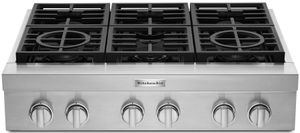
Cooks who came up using a KitchenAid mixer tend to trust the badge on a burner too, and this 36-inch gas rangetop earns that trust with straightforward pro capability. The stainless surface handles the full range of home cooking, from weeknight pans to holiday multitasking, and it fits the same 36-inch cabinet plan most kitchens are already built around. Consider it the practical middle of this lineup, aimed at the family cook stepping up to a professional surface without overhauling the entire kitchen budget.
Top Features
- 36-inch professional format: Drops into a standard pro cabinet plan with front controls and a raised back panel.
- Stainless steel finish: Coordinates easily with existing appliances and holds up to daily cleaning.
- Pro-style knob control: Direct mechanical adjustment for quick changes between high heat and low.
- Wall oven pairing: Built for kitchens moving the oven to eye level in a nearby cabinet run.
Thor Kitchen Professional 36” Gas Rangetop
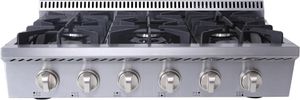
Not every serious cook has a luxury budget, and this is where Thor Kitchen makes its case. The Professional 36-inch stainless rangetop delivers the pro-style look and front-knob control of far pricier surfaces at a price that leaves room in the project for the hood and wall ovens the install actually requires. It suits the remodeler building a professional kitchen in stages, or a second kitchen, casita or guest house where the cooking surface still needs to perform.
Top Features
- Professional series build: Commercial-inspired proportions and heavy stainless construction.
- 36-inch width: Fits the most common pro cabinet opening and hood size.
- Front knob control: Familiar, immediate flame adjustment without reaching over hot cookware.
- Value positioning: Leaves budget available for correct ventilation and cabinet work.
Café 48” Gas Rangetop with Integrated Griddle
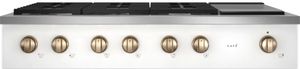
Breakfast for eight stops being a logistics problem when the griddle is built in. This 48-inch Café rangetop pairs a full burner array with an integrated griddle in a matte white finish that reads custom rather than commercial, and the hardware can be personalized to match your cabinet pulls. Width like this belongs to the entertainer running several dishes at once, and the griddle handles pancakes, smash burgers, fajitas and tortillas without a pan. Pair it with a hood sized for 48 inches.
Top Features
- 48-inch cooking surface: Room for multiple large pans plus the griddle without crowding.
- Integrated griddle: A dedicated flat surface for breakfast volume, tortillas and searing.
- Matte white finish: A designer alternative to stainless that anchors light and bright kitchens.
- Customizable hardware: Knob and handle finishes can be personalized to match your kitchen.
Thermador Professional 36” Gas Rangetop
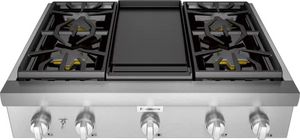
Thermador built its reputation on burner design, and this Professional 36-inch natural gas rangetop is where that reputation lives. The stainless surface is engineered for cooks who care as much about holding a low flame under a sauce as they do about searing hard, and it anchors a full Thermador suite with matching wall ovens and ventilation. This is the pick for the enthusiast cook who plans the kitchen around the cooking surface rather than fitting the surface into whatever the kitchen already has.
Top Features
- Professional series engineering: Built to Thermador’s pro standards for burner performance and durability.
- Natural gas configuration: Ready for homes on city gas service, with conversion handled at installation when needed.
- 36-inch stainless surface: The category’s most flexible width in a finish that matches any pro suite.
- Suite anchor: Coordinates with Thermador wall ovens, ventilation and refrigeration columns.
Cook Like a Pro With the Right Rangetop Cooktop
A rangetop cooktop separates itself through burner power at the top end and genuine simmer control at the bottom, with modules that let you shape the surface around your cooking. Burner mix and module choice drive daily results far more than width does, and ventilation and installation planning deserve as much attention as the unit itself. Get those three right and the surface will still be performing two decades from now.
Come see the burners lit. At Texas Appliance, you can compare pro-style rangetops side by side, watch the flame step from a hard sear down to a true simmer, and talk through hood sizing and cabinet requirements with specialists who do this every day. Our team handles gas conversion, coordinates professional installation, and backs the sale with local service that big-box stores cannot match on displays they rarely stock. Visit a Texas Appliance showroom or contact our team for a configuration recommendation built around the way you cook.
Read more:
5 Best Slide In Electric Ranges for Your Kitchen
30 Inch Range Features You Need to Know
Frequently Asked Questions about Rangetop Cooktops
A rangetop cooktop is a professional drop-in surface with front-mounted knobs and a raised back panel that installs into a full-depth cabinet, while a regular cooktop sits flush in the countertop with shallow depth and often top-mounted controls. The rangetop requires cabinet modification and pairs with separate wall ovens, which is why it is a kitchen plan rather than a simple swap.
Most home cooks are well served by at least one burner in the 18,000 to 20,000 BTU range for searing and fast boiling, with the rest between 9,000 and 15,000. Simmer capability at the low end matters just as much, since a burner that cannot hold a gentle flame limits you more often than one that cannot reach maximum heat.
Sealed burners are easier to clean because spills stay on the cooking surface, while open burners offer flame character and heat spread that many experienced cooks prefer. Neither is universally better, so the choice comes down to whether cleanup convenience or flame performance matters more in your kitchen.
Your hood should match or exceed the width of the rangetop, and CFM should be sized to the combined BTU output of all burners and modules. Island installations require more capacity than wall installations because there are no side walls to contain rising heat and grease.
Professional rangetops typically start in the low four figures and rise well beyond that for 48-inch and 60-inch configurations, with hood, duct work, wall ovens and cabinet modification adding significantly to the project. Comparing the full installed project against a pro-style range plus hood gives you an honest number.
Yes, in practical terms, because a rangetop has no oven beneath it and most kitchens need baking and roasting capability. Wall ovens are the standard pairing, and placing them at eye level in a nearby cabinet run is one of the main reasons cooks choose this configuration.
Why Trust Texas Appliance?
With roots back to the 1950s, Texas Appliance is an established, locally owned and operated, residential major appliance retailer serving both residential and builders’ needs. Our 4 locations allow us to offer a full spectrum of appliances to meet your every need. With over 40 major quality brands, Texas Appliance has one of the largest displays of built–in and free–standing appliances in the state of Texas.
We will be the best appliance dealer in our markets by exceeding our customers' expectations in every way. We will treat our customers, vendors and fellow employees with respect, honesty, integrity and appreciation. The difference between a "Good" company and a "Great" company lies in its' employees' determination.
Shop Rangetops at Texas Appliance
Stop by Texas Appliance’s Fort Worth Store and Outlet locations to see what a difference buying local with an experienced staff can make. Or shop Mattresses online! Our friendly experts are always happy to help you find the best Sealy mattresses for your bedroom — whether you call us at 817-299-2800, use our online chat feature, or visit us in person.